Tuesday, May 17, 2011

Bugs: Caterpillars II

Well, not quite sure how the "One Last Bug Activity" post got reposted for yesterday...but I must have clicked something.  :-)  Oh well, live and learn.  Yesterday's post was actually Bugs: Caterpillars.

I wanted to get in some syllable explorations again. http://www.kidssoup.com/ have word wall strips with a simple word and picture all within a theme.  They have a caterpillar/butterfly theme which I was going to use this morning but ended up using our bug vocabulary cards I made last year.  We'll do the word wall strips another time.  :-)  Just not enough time in a morning/week to get everything I'd like to do accomplished!  So, sorted by number of chunks.  This time we used our bug rhythm instruments instead of just clapping, definitely gets the excitement going for the activities that are repeated often.
The instruments were from Target's dollar section.  They have some really neat things but really aren't made for a lot of use like they get in our program.  We have higher quality rhythm instruments, made to last, but these themed ones definitely are enjoyed while they are here! The plastic tactile numbers are used in so many activities.  I love them!

Check out their faces!  Concentration on the left and ICK! on the right.  :-P
We created a texture caterpillar.  Children traced a cup to create circles and then spread glue inside and chose what materials to place on each circle.  Then they added details as they wished.  Tracing around cups make a great fine motor activity and requires them to have a bit of coordination.  :-)  I ended up helping the 3 year old.  The 4 year old wanted help with the first tracing but felt like she could do it on her own, and she did, and the 5 year old asked for no help at all. 

For math, I've seen this activity on various websites.  I was going to create my own mats but decided to use the ones available. They had rows with a number on the left and the children created a caterpillar with that many circles. So http://www.lessonsense.com/ and http://www.kidssoup.com/ are the two sites from which I got the printables from.  Children stated what the numeral was and used corks and stamp pads to create a caterpillar that had a corresponding number of body parts.  I did provide various size corks in order for the children to review size and have a bit of choice in the matter.  :-)  Site note:  My students haven't gotten to where they are by "just exploring", though that is a big portion of our program.  There has been instruction and there has been "have to's".  Some people might feel differently about having "have to's" in preschool.  I've been in programs who have had the attitude that they'll learn what they need just by exploring with the materials.  I've also been in programs who have a very nice "happy medium" going on.  That's what I strive for.  One thing I do to counteract the "have to's" is to provide extra materials so they can explore to their heart's content afterwards.  This type of activity especially.  The three year old is definitely more in the exploration stage so I had extra paper available and after I worked with him on his caterpillars, he printed with the corks on another paper to his heart's content.  He even verbally labeled it "Camel Prints"!  That was exciting...he's just starting to label his work on his own.  Anyway...I did remove the yellow and orange stamp pads.  Why?  Well, I know some who have the funding to replace stamp pads and etc as often as necessary, but I don't...so I'm a stickler about mixing the colors on a stamp pad.  My oldest student and my own boys know to wipe off their printing tools or stamps before switching to a new color (another function for the store brand "art" wipes.)  But at 3 and even some 4s, I can't really expect that.  So I remove the light colors so it's less noticeable when they "mix".  :-P
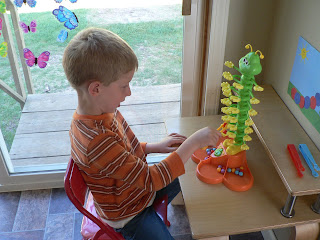
 
We also played Scatterpillar Scramble today.  We use it as a one person activity during our kitchen time.  They enjoy playing together also, but with the younger students, it works best to cut that competition piece right out.  It also encourages them to sort by color.   I encourage them to try to do it while it's wiggling but it's okay to stop it and work with it still also.  When we first got it, I even had a hard time getting them all on when it was wiggling! By the time they are 4.5+ they are getting pretty good, depending on past fine motor skill exposure.  Of course this game lets off a very contagious laugh at the beginning.  Makes for a very light hearted morning, that's for sure!

Daily scissors:  Children cut a leaf from construction paper and created a ...well, the suggestion was a caterpillar.  :-)  Side note:  I decided against "doing" The Very Hungry Caterpillar this year since I've done it every year for the past 6.  Taking a break...but it's an EXCELLENT book!  Great for sequencing, counting sets, days of the week, healthy/unhealthy foods, caterpillar to butterfly cycles and so on.  But it wouldn't be a caterpillar/butterfly week without at least reading Eric Carle's The Very Hungry Caterpillar.  Anyway, we brought that book back out to check out the leaves and how the caterpillar ate "right through".  Then then they tried to punched the leaf with a hole punch to make it look like their caterpillar was eating right through it.  It wasn't easy for them.  One child ended up using scissors because the hole puncher wasn't working just the way he wanted.  If you know of a brand of hole punches that actually work with preschoolers, I'd love to hear about them!  They had a choice of fingerprints, buttons, foamies, or pom poms to create their caterpillars.  One child had a really LONG caterpillar which went a few times around his leaf.  :-)  Another turned his buttons into a cocoon.  Love that they know that "it's their work" and I respect that.  Please encourage them to be creative and think on their own.  If you put them in public school, unfortunately...especially around here...they aren't going to get much experience/tolerance for that freedom.

Well, better stop for now and gather materials for tomorrow...we will be moving more into the focus of butterflies.  :-)  Oh yes, wanted to mention yesterday that we got on the conversation of bugs that are symmetrical. Butterflies are perfect insects to introduce/reinforce this concept.  Remember, never too early to introduce a topic! 


Monday, May 16, 2011

One last bug activity...

Time is short these next couple of days so I'll share one last bug activity we did today that turned out nicely.  I did this 1:1, and to get the most out of the activity, I suggest you do the same. 


And a close up of one of them...

*  Children chose the numbers they wanted instead of me choosing which numbers to use.  Mainly because all the numbers, with the exception of numeral one, need practice.
*  Equal, more, and less are math terms we use daily.  The older ones obviously grasp the concept, the 4 year old understood more but was challenged with coming up with a number less than.  Which, not surprisingly...she understands adding sets but has more difficulty with subtracting from a set.  Tends to go hand in hand.  :-)  The three year old needed help in both more and less but once we added in our fingers as manipulatives he was successful.    We kept it short and sweet for him and did only two numbers.  We did three numbers with the 4 year old and four numbers with the 5 year olds. 
*  Stickers easily make an activity theme related and adds a nice fine motor component.  You could have your child use stamps as a variation if you desired.  I know stickers can add some expense! 
*  When children are forming the numbers, encourage proper formation.  Either write the number on a scrap paper to show them or use tactile numbers to trace.  I always sing part of the number formation song as we write it.  Hand over hand is quite appropriate if need be. 
*  I did not suggest they do 1 more or 1 less.  Any number they gave me that was more/less was acceptable.  Allows for a little more "choice" in the activity.  If you are introducing or working with a number line you may wish to do just one more or one less.
* Reinforce that "none" equals zero.  At first I was disappointed when they chose the number one but it turned out well because we were able to reinforce the number zero.  The kiddos who haven't been with me as long as the others needed that reinforcement.
*  I did use the symbols for equal, more, and less.  Do I expect them to remember the more/less symbols?  Not really...but it helps with future learning.  It'll look familiar to them when they enter grade school and they begin to see those symbols.  The equal sign they all tend to remember because we use it so frequently and that will help with math facts and so on.
*  Something I may change in the future:  I may use a larger sheet so that there is room to write each  numeral in the boxes, especially for the older ones.  Get more number formation practice in. 
*  Something I'd keep the same:  I had folded the paper and then traced on the folds with crayon to easily mark each box.  That worked very well as a visual.


Bugs: Caterpillars

So this week we'll be focusing on caterpillars and butterflies.  Have some activities we didn't get to last week so will slip them in when we can. 


We started out working with our C number caterpillar, to reinforce the letter C (magic c line that is used in letter formation) as well as reinforce number recognition and order.  Then I made it clear that this was an activity they can use on their own.  (Laminated and used velcro dots.)
I made this when Aaron was about 2.5 years (he's 8 now) it's held up well. 


We also used the butterfly cycle from http://www.kidssoup.com/.  Actually, what was really neat was one child remembered another cycle (water cycle) and so we were singing our water cycle song too!  :-)  We also reinforce the shape oval today since the cycle was in an oval shape and so was our caterpillar pieces.
So the caterpillars are what we did during scissors today. They only cut the 4 oval body parts out as the antenna and legs would be a bit frustrating for all of them.  The printable is at http://www.sparklebox.co.uk/2481-2485/sb2485.html.
They call them split-pin minibeast characters and there is more then just the caterpillar.
Last week we did the 5 senses study about honey.  You can do this with most anything and it's a great way to review the five senses, take dictation, reinforce chart making and etc.

Pattern caterpillars
Though the patterns on the Kindergarten report card are ABAB, ABB, ABC and etc...anything that came home from school pretty much was encouraging an ABAB pattern. And that is what the old report cards were focusing on, ABAB.  Caleb did bring 1 or 2 items home that I could tell he had freedom to make his own because it wasn't ABAB.  :-)  He was past ABAB patterns at 3 years old...and that is what I find.  3 year olds, with experience, can grasp what an ABAB pattern is.  First you start out with physical patterning (clap, slap, clap, slap) then you move on to copying a pattern, then extending, then creating their own.  So my 3 year old today did that ABAB pattern (middle).  The 4 year old did an AABB pattern on her own (bottom) and the 5 year old did an ABCC pattern after I told her she could NOT do an ABAB pattern.  :-P  I love to hear my preschoolers tell me what kind of pattern it is!  Yes, they use ABAB or ABB terms.  :-P
I purchased a bunch of these chip and dip containers on clearance after halloween one year.  They are perfect for sorting activities but also for helping to instill an appreciation for organization.  I slipped in a little literacy by writing the color words, in corresponding colors, on tabs and sticking them on the plate where each of the colors were.   Knowing color words is not something they typically learn in preschool but they do fall under 'sight words' in Kindergarten so introduce it now!  It also helps reinforce that every word is made up with individual letters.  I often slip in chunking (syllable clapping) and beginning sounds with color words.

Art
Well, I changed my plans for today because my computer/work room was a disaster and could I find my lids for squish caterpillars, no way.  So, since we hadn't done free painting with brushes lately, I decided this was a good day to do that and wow!  Check out those butterflies and caterpillars! This is what happens when we do a theme...I really don't have to suggest anything.  The top is from the 5 year old, left bottom is a 4 year old and right bottom is the 3 year old who was exploring with color mixing (right on for his age).  I did have a fork available and I mentioned that forks make neat grass prints if they were interested...but left it at that since this was THEIR work.  Children should have many opportunities for "free painting".  :-)

We also pulled out the pattern blocks today to use with caterpillar and butterfly mats.  I have a set of pattern cards that I have purchased but PreKinders have free pattern block printables.  I print double sided, b/w on one side and colored on the other.  The colored side is much easier for the littler ones.  Remember to introduce/reinforce those nontraditional shapes, trapazoid, hexagon and diamond. 

Wednesday, May 11, 2011

Bugs II

A side note:  I heard a child say to another "I frustrated in you".  :-)  Brought a big smile to my face.  Teaching about feelings is very important.  Most of it is done informally, through conversation, helping a child through problem solving steps that include stating feelings, and being verbal and labeling what you yourself are feeling.  But there are some "emotions" activities you can do and that would be a good future blog.  :-)  Especially when we receive our new toys from amazon that is focused on feelings.  So, stay tuned!

Yesterday I spent much of my day in Lansing and then in Bay City in the evening as the parent rep for the QRIS project.  QRIS stands for Quality Rating Improvement System that the state of MI is in the process of implementing to boost quality in child care/preschools.  It was a very profitable day...helped me see a little of where they are going and how they are working together to create a feasible system for the various types of early childhood settings.  I'm excited!  Another parent focus group is Monday the 16th at the BAISD.  Please come if you are from this area.  Contact me for more information.

---------------------------------------------------------------------------------------------
So, onto BUGS!
Day number 2.

Maybe I'll break it up like I do when I lesson plan.  Please keep in mind that so much more is done then just these activities.  But planning like this helps me make sure that the children experience a little of everything every day.  Also, I would like to remind you that there is no reason to "recreate the wheel".  There are so many ideas out there...use them! 

Literacy:  Bb is for Bees (Mailbox)


I chose five "leapfrog" consonants to review recognition, sound and capital letter review.  F, D, P, R, B.   My 3 and 4 year old understand exactly what I mean when I say a "leapfrog letter".  They know, line down from top to bottom and leapfrog back up to the top of the line.  My newer child hasn't experienced this before so I really wanted to review them. It's so hard to break a habit!  Start young teaching them the correct way!!! Another thing I teach is to not pick up their pencil/writing tool/finger if not necessary to.   Another tip for the children is to start their letters at the top and their circles should be started top, off center just a wee bit to the right, drawing the circle to the left.  As you can see here, K. definitely knows how to form an R.  Someone who doesn't know the correct formation will do a circle at the top and two lines out on angles at the bottom, all done separately.  That's because it's how they see it.  Here we can see she did the leapfrog line and closed the circle in and made her leg without picking up her finger.  Excellent!  By the time she goes to school she'll have letter formation down pat!  The three year old also does very well with letter formation because he was just beginning to explore when he came to my program and so the correct habits are already in place.  Am I picky about letter formation?  You bet!  And I'm not going to apologize for it!   :-P  Tactile letters are excellent for helping a child learn how to form their letters.  My sandpaper alphabet set came from www.amazon.com for only $11.55 for both upper and lower case letters.

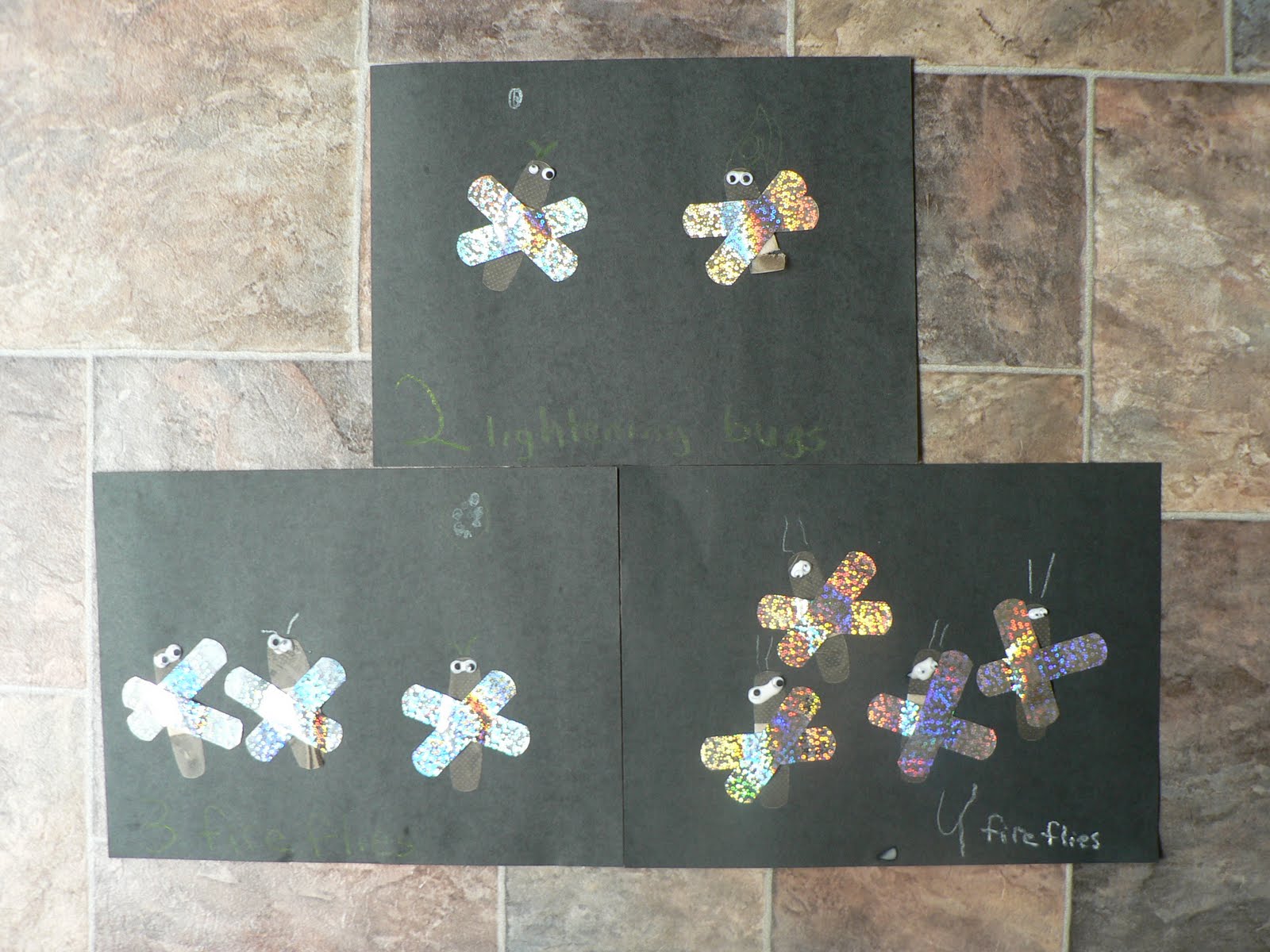
Fine Motor:  Band-Aid Lightening Bugs (www.notimeforflashcards.com)
There you have it.  :-P  We wrote the number of lightening bugs (or fire flies) at the bottom of the paper.  They did as many as they wanted.  Peeling the backing off of bandages without getting them the stick on itself takes a bit of fine motor.  Meijer was out of the neon bandages (which happen to be on sale) but they had sparkle ones...so they turned out pretty cute that way too.  We used regular brown ones for the body.

Scissors:  Where are the Bees? (Mailbox)
Here is the beehive.
Where are the bees?
Hidden away, so no one sees.
Here they come creeping, out of the hive.
1, 2, 3, 4, 5
Children cut out the hive and wrote the numbers across the bottom of the fingerplay words,which they glued to their hive.  Then they taped their hive onto the white paper and added and decorated 5 yellow fingerprints to make them bees.  They enjoyed this. (The little tab of yellow is just covering a name, is all.  We respect the wishes of families who do not wish to have their children's pictures or names posted.)

Math:  Ladybug Sorting/Matching (www.childcareland.com)
These were both very easy activities for my kiddos but I wanted a quick, hands on activity that I could observe for their assessments.  So size, color, and shape.

Sensory:  Bugs in Shaving Cream (Bugs are a set from Toys R Us.  Nice details!)
Wasn't exactly what I had planned today but because of time and energy last night...I went the easy route.  Next week we'll do goop and the bugs.  :-)  That's liquid starch and liquid glue. 

Art:  Flyswatter Flower Garden (OUTDOORS!!!)
Well, maybe it didn't turn into a beautiful garden but the process was fun!  The older child here actually got the hang of slapping the flyswatter down multiple times and so she had some beautiful flower prints.  The younger ones were into the effect of having a glob of paint and splatting it.  Speckled we were when we were done.  :-)  I might try it with my summer group if time allows and see what we can do with it.  We purchased the flower and butterfly flyswatters from Dollar Tree.  I have seen basic shape swatters at www.discountschoolsupply.com

And we even got a chance to eat lunch outside before it rained!  :-)  That was neat in itself though.  Watching the change of the sky, feeling the change in the wind and temperature...and the little scientists..."Ms. Amber, it's going to rain!"  :-)  "Notices and describes changes in natural environment".  Love it!  We haven't got the rain yet but...sooner then later probably.  Too bad the garden isn't in!


Monday, May 9, 2011

Bugs! :-P

For Mother's Day I received a color laser printer!!!!  THANK YOU DONNIE!  :-P  Now we won't have to worry about smearing our ink as much.  I'm so excited!!!


Oh, we had fun this morning.  :-)  They really got into the the "dramatics" of finding bugs   We had all sorts of squeals going on.  Makes for a fun sorting activity! 
I'm big on verbal language and really try to get children to describe, predict, "analyze" what they do.  One of our goals on our assessment is to be able to sort by at least one characteristic and then describe why they sorted that way.  The easiest characteristic to sort by is color and most of them can do that on their own but sometimes can't label that they are sorting by color.  After they are able to sort by one characteristic easily, we take it a step further.  These bugs from the Target dollar section are perfect for taking it a step further.   We can easily sort by color but then we can sort by type of bug within that color.  So we'll be doing that this week also.  (These are stretchy bugs...and though I can't put them in a wet sensory like I wanted to...they add their own sensory component.)

Buzzin' to the Beat
This was an idea from a Mailbox publication...and the patterns were from there also.  You could easily adapt any animal/theme.  I placed a large sheet of paper vertical on the wall for each child.  It went above their heads to the floor.  Just add a little variation to our typical horizontal, cooperative work.  They didn't spend a lot of time here but they sure got into it.  I'll be leaving it up throughout the day so if they want to go back to it they can.  I used a CD I created that had all fast classical music.  We got complete different reactions to the music.  It's so neat to see!

Bugs in the Flower Garden
This is a VERY simple activity but they really took to it!
  I was going to glue googly eyes on the pom poms but decided against it.  I thought they'd grab at the edge of the bug container...so we left them plain.  I used the dollar store plate as the "flower garden" and the children "caught" all the bugs.  Then as they put them back in the "garden" for the next child we counted them, talked about their color and size (big, medium, and small).  I'm sure this is one that will get left out also as they enjoyed it.  Wish I had space to leave activities out more often but...oh well, we work with what we have!

Since I blogged about puzzles recently, maybe I'll share one that we did together as a group.  This was an "inherited" puzzle set.  Not sure who I got it from but it's so nice.  Will need to look and see if they have something similar to it on Amazon or elsewhere.  I haven't seen anything like it lately.  If you are aware where I could purchase a set like this, please let me know!
Color review, logical thinking, and  turn taking.  The spinner added a nice component also.  Interesting to see who could actually "flick" the spinner.  We actually played this "game" after reading The Color Bugs reader from http://prekinders.com/bugs-theme/ (free printable).
When we read this book, we went from child to child and they told us what color the bug was and where the color word was in the sentence.  The 3-5 year olds repeated the color emphasizing the beginning sound for most of the words, all on their own.  One child had a black bug but the wings were a little blue.  So she said "blue" and I said, "Let's look at this word again."  She sounded it out!!!  Black!  Wow...what a big smile that caused for me and the child.  I laminated these pages and we used dry erase marker to underline the color word...if you choose to use this book you may wish to have your child underline the color with a corresponding crayon.  Provide a pointer and this book is perfect for a preschooler to practice "reading".  They are only 3 words and they are very predictable.  A color bug.  Having them "read" these books build confidence as well as reinforces some important literacy concepts such as left to write, letters make a word, words make sentences, etc.

Sunday, May 8, 2011

A Word about Assessments

Okay...brag moment, then I'll let it go because really, was it all me?  No, most likely not.  But it does make me feel successful! 
So, May is here and we do our final assessment of the year.  This past week, I worked 1:1 with the student going to Kindergarten this fall.  We focused on what he knew about the alphabet.  The results:
* matched upper to lower case letters 25/26!!!
* stated the name of upper case letters 26/26-lower case letters 24/26
* sounds of the letters 22/26 + missing a long vowel sound (which I really don't get into)
* beginning sounds, create a word 25/26, well, 24 out of 26 because he said socks for the x sound...but I took that one.  He heard the sound (we emphasize ending sounds for the letter x because x-ray...well, okay.  But xylophone...doesn't even make the x sound.)

Comments...I got rhyming words frequently with the statement they rhymed and the words were not "typical" symbols of letter sounds...which I really worked on these last couple of months.  I didn't want memorized ones from my kiddo going to Kindergarten.  I really wanted to know he could hear the sound and come up with various words. 

The 4 year old...we started...but I do it in multiple sessions as I want a good feel of what she knows....not her "tired" responses.  :-)  She has gone forward from her last assessment in January also.  Yeah! 

-------------------------------------------------------------------------------------------------------------
So, my opinion about assessments. 

*  Assessments are assessing how well I'm teaching as much as finding out what the child's progress is and what we need to work on.

*  A three times a year assessment is most beneficial.  Work, a little...but very beneficial!  First off in the month of September...it helps me get a good feel for where they are at.  January, well, it's middle of the year and after break so I can find out if they "lost" anything and especially if they are heading to Kindergarten, what I really need to be incorporating.  And of course the final assessment in May gives us an end view...so we can see where they started and where they ended.  Having it on paper where you can see the progress is so nice!  This year I'm adding pictures throughout the year to the left side of each page for the final printout for the parents.  A little "keepsake".  

*  Do I test?  I don't consider what I do "testing".  I get as much as I can informally...by setting up the environment...planning certain activities and then stepping back and observing.  If I do have to do a "sit down"...often with something like the whole alphabet...then I use a hands-on approach.  The children know that it's okay to say "I don't know" if they really don't know it.  I actually take the route that what I'm seeing how well I taught.  :-)  They think that's pretty funny!  

*  What assessment do I use?  I have created my own.  I could purchase a curriculum and they typically have the assessments that go along with it...but for my program, I can't afford to do that.  And really, I don't particularly care for many of the assessments.  Some categories are more general then I care for.  For example, the category of literacy is so broad!  In my own assessment I have broken it up into several categories and have several points within each one.  It helps me with my planning (making sure I'm not missing anything) and it really gives the adults a better picture of where the child is at.  My assessment is one created to directly correlate with what I teach.  I have been in many a program who have curriculum and assessment tools "in place" but the teacher isn't teaching accordingly so really, how can you expect a child to "make progress" if you aren't setting the environment up to help them experience all of what you are assessing?  

*  Proof?  It's always wise to take notes about why you have stated what you did on an assessment.  From a formal preschool point of view...you are going to want to be able to tell the parent/guardian why the child is "still developing" or is at a "forerunner" still or you know the child has accomplished the goal.  From a home-schooling point of view (and hopefully a formal preschool teacher's, as well), this gives you something to jog your memory...because really...it's easy to forget certain situations that lead you to believe that they do have or do not have a specific skill.  I also found that some teachers state that a child is accomplished at a skill at the first assessment and then instead of reassessing that, they just don't bother (time is always precious, right?).  My qualm with that is that some children are really still "developing" even if they give the right answer or show the skill every once in awhile.   I have that situation right now.  A child who "seemed" to have grasped the concept but then throughout the weeks after I can see that sometimes they do and sometimes they don't...and to me that does not equal "accomplished".  :-)  That is still developing.   But soon that child will grasp it!  She has another whole year with me.  :-P  I'm not worried at all! 

*  Repetition.  Children need repetition...so after you have assessed them and they have seemingly accomplished a goal...please don't stop providing those types of activities.  Yes, seems silly for me to say that but I've seen that happen!  They need constant review so that those brain connections are firmly made! It brings to mind the "letter of the week" programs.  Yes, some people have success with that...usually home schooling parents or small group preschool...but often in a larger setting, they do that one letter a week, assess whether they know it and move onto the next with minimal to no review of the previous letter.  And really, if they are going A-Z order....um, it's really not all that meaningful!  So if something isn't all that meaningful to a child...what's the possibility they are going to retain it?  Personal opinion of course! :-) I'm full of those!

There is so much out there about assessments and early childhood anymore!  Yeah!  And the nice thing is that all have the same general idea about what's appropriate (and I guess it's a good thing I agree :-P).  One thing I really like to do is to check out other state's early childhood curriculum frameworks.  Something you may wish to do when you have a few moments.  :-)  Just google "preschool and assessments" or "preschool and curriculum"  or "early childhood state standards" etc.  Also, remember http://www.naeyc.org/.  Have fun! 

Friday, May 6, 2011

Puzzles

Trent enjoys puzzles...he's left handed...oh, what does that have to do with anything?  LOL  Hmmm....another blog!  L. tends to think he "can't" do puzzles over 12 pieces.  :-P  But with a little encouragement...voila!  All by himself.  He was so proud of himself!  Now onto a 24 piece!  K. is retelling Little Red Riding Hood! I don't think she even knew I took a picture.  It was completely all on her own! LOVE IT!!!

 
I'll start by sharing a little blurb from another's blog.  You can read the whole article at
http://hubpages.com/hub/Educational-Toys-for-Kids-The-Benefits-of-Puzzles

Here are some of the skills that are enhanced by playing with puzzles:
  1. Cognitive skills: Puzzles improve a child's problem solving and reasoning skills. It helps them to see whole-part relationships, increases their visual spacial awareness and depending on the subject matter can teach them a variety of topics like the Alphabet, Numbers, Color recognition, shape recognition, categories like pets or transportation vehicles, and more.
  2. Fine motor skills: Puzzles are fun way to improve fine motor skills. From the time a baby can start eating solid food parents give their children cheerios to help a child with their pincher grasp. Fine motor manipulation is key for writing but but children start learning this skill long before they can hold a crayon or a pencil. Various types of puzzles like peg puzzles and chunky can help teach little ones to pick up and grasp pieces and they aid in the development of the pincher grasp.
  3. Hand-eye coordination: As a child places each piece in the puzzle they are manipulating it so see if it fits. Their hand eye coordination is enhanced through this trial and error process.
  4. Social skills: Puzzles can be done alone but are also a great tool for fostering cooperative play. As kids ask for a piece to be passed to them, or discuss where a piece should go they are sharing the task and learning to cooperate. It can also help a child learn how to handle frustration when a piece does not fit.
------------------------------------------------------------------------------------------------------------------------------------

I agree with what this individual has posted.  It's good to think about the reasons why certain toys/manipulatives are beneficial.   There are so many different types of puzzles.  They vary in number pieces, material it's made out of, peg/no peg, large/small peg, jigsaw etc.  What I have on the assessment I use is that a child, at the end of their preschool years, is able to complete a 12 piece jigsaw puzzle.  That is actually "harder" then what many preschool assessments state.  Usually I see a 6-8 piece puzzle.  But, like with anything, when a child works with something and has been taught how to do it...they advance.  I find that my students often leave with the ability to do up to a 24 piece puzzle.  My own boys did 63-100 piece before Kindergarten.  Part of it has to do with their personality and natural ability for logical thinking but most of all it's experience. 

The logical thinking that is working in the background as they try to do a puzzle will eventually help them be able to think about larger problems and solve them.  We definitely want that.  Also, I find that many children just don't notice details and so I find that puzzle activities helps them in this regard.  Noticing details will help them with writing letters/numbers, drawing, patterning and more!

The small pegs are great for encouraging the tripod grasp. 
The complete article might be beneficial for you.

Well, what do you do if your child is past these peg puzzles but still could use the fine motor experience of them?  That's very often the case, I find.  They consider the peg puzzles "baby puzzles".  Well, breathe some new life into them.  :-)

*  If you are missing pieces...use the others for stamping.  Most are a basic shape and will print nicely on a paper.
*  Remove the puzzle pieces and place them into a sensory tub of rice, lentils, or other "clean" sensory.  Then they can find them and put them back in the board.
*  Hide them around the room...better yet, have them hide them for you and you bring them back for the child to put back in the board.
*  And my favorite...use them for creating or retelling stories.  Peg puzzles can be great story starters.  And often you can find classic story puzzles at the dollar store that work GREAT for retelling/sequencing.


This past school year I found that puzzles got put on "the back shelf".  I very seldom noticed the children getting out the puzzles.  Hmmm.  Not good, at least from my perspective.  :-)  Part of it is interest...I hadn't really worked on creating an interest with them.  Part of it was that we had to move our main shelf and though the puzzles were kept under the shelf, just like the old one...however, they weren't as noticeable.  So, I started putting one puzzle out on one of the desks in the kitchen. That really helped!  It was like ..."oh yeah, Ms. Amber always puts out puzzles."  Now I see them pulling them out more frequently.  I rotate my puzzles every 1-2 weeks and provide a variety of types.  Large floor puzzles are perfect for getting the children to work together!  I also find that putting an older child with a younger child is great too.  In those cases I observe the older child pointing out and verbalizing about the details.   My favorite was when a child was doing one of our 12 piece alphabet puzzle and another was watching and the child was trying to put a non edge piece on the edge.  The observer said, "No, that's not right. See the perimeter is pink. There's no pink on yours."   Wouldn't that put a smile on your face?  It did mine.  Yes, I think the word "perimeter" is brought up in conversation almost every day....we use it with gluing, in math, with puzzles, during large motor and so on.  So when they hit 2nd grade and they are starting to learn about perimeter (like the work my son brought home from school yesterday)...it will be easy for them.  :-P

I'd like to have a set puzzle time and I may just work it in one of these days.  :-)  There is just not enough time in the day!!!  Be sure to encourage your child to pull out a puzzle today!  :-P