Sunday, May 8, 2011

A Word about Assessments

Okay...brag moment, then I'll let it go because really, was it all me?  No, most likely not.  But it does make me feel successful! 
So, May is here and we do our final assessment of the year.  This past week, I worked 1:1 with the student going to Kindergarten this fall.  We focused on what he knew about the alphabet.  The results:
* matched upper to lower case letters 25/26!!!
* stated the name of upper case letters 26/26-lower case letters 24/26
* sounds of the letters 22/26 + missing a long vowel sound (which I really don't get into)
* beginning sounds, create a word 25/26, well, 24 out of 26 because he said socks for the x sound...but I took that one.  He heard the sound (we emphasize ending sounds for the letter x because x-ray...well, okay.  But xylophone...doesn't even make the x sound.)

Comments...I got rhyming words frequently with the statement they rhymed and the words were not "typical" symbols of letter sounds...which I really worked on these last couple of months.  I didn't want memorized ones from my kiddo going to Kindergarten.  I really wanted to know he could hear the sound and come up with various words. 

The 4 year old...we started...but I do it in multiple sessions as I want a good feel of what she knows....not her "tired" responses.  :-)  She has gone forward from her last assessment in January also.  Yeah! 

-------------------------------------------------------------------------------------------------------------
So, my opinion about assessments. 

*  Assessments are assessing how well I'm teaching as much as finding out what the child's progress is and what we need to work on.

*  A three times a year assessment is most beneficial.  Work, a little...but very beneficial!  First off in the month of September...it helps me get a good feel for where they are at.  January, well, it's middle of the year and after break so I can find out if they "lost" anything and especially if they are heading to Kindergarten, what I really need to be incorporating.  And of course the final assessment in May gives us an end view...so we can see where they started and where they ended.  Having it on paper where you can see the progress is so nice!  This year I'm adding pictures throughout the year to the left side of each page for the final printout for the parents.  A little "keepsake".  

*  Do I test?  I don't consider what I do "testing".  I get as much as I can informally...by setting up the environment...planning certain activities and then stepping back and observing.  If I do have to do a "sit down"...often with something like the whole alphabet...then I use a hands-on approach.  The children know that it's okay to say "I don't know" if they really don't know it.  I actually take the route that what I'm seeing how well I taught.  :-)  They think that's pretty funny!  

*  What assessment do I use?  I have created my own.  I could purchase a curriculum and they typically have the assessments that go along with it...but for my program, I can't afford to do that.  And really, I don't particularly care for many of the assessments.  Some categories are more general then I care for.  For example, the category of literacy is so broad!  In my own assessment I have broken it up into several categories and have several points within each one.  It helps me with my planning (making sure I'm not missing anything) and it really gives the adults a better picture of where the child is at.  My assessment is one created to directly correlate with what I teach.  I have been in many a program who have curriculum and assessment tools "in place" but the teacher isn't teaching accordingly so really, how can you expect a child to "make progress" if you aren't setting the environment up to help them experience all of what you are assessing?  

*  Proof?  It's always wise to take notes about why you have stated what you did on an assessment.  From a formal preschool point of view...you are going to want to be able to tell the parent/guardian why the child is "still developing" or is at a "forerunner" still or you know the child has accomplished the goal.  From a home-schooling point of view (and hopefully a formal preschool teacher's, as well), this gives you something to jog your memory...because really...it's easy to forget certain situations that lead you to believe that they do have or do not have a specific skill.  I also found that some teachers state that a child is accomplished at a skill at the first assessment and then instead of reassessing that, they just don't bother (time is always precious, right?).  My qualm with that is that some children are really still "developing" even if they give the right answer or show the skill every once in awhile.   I have that situation right now.  A child who "seemed" to have grasped the concept but then throughout the weeks after I can see that sometimes they do and sometimes they don't...and to me that does not equal "accomplished".  :-)  That is still developing.   But soon that child will grasp it!  She has another whole year with me.  :-P  I'm not worried at all! 

*  Repetition.  Children need repetition...so after you have assessed them and they have seemingly accomplished a goal...please don't stop providing those types of activities.  Yes, seems silly for me to say that but I've seen that happen!  They need constant review so that those brain connections are firmly made! It brings to mind the "letter of the week" programs.  Yes, some people have success with that...usually home schooling parents or small group preschool...but often in a larger setting, they do that one letter a week, assess whether they know it and move onto the next with minimal to no review of the previous letter.  And really, if they are going A-Z order....um, it's really not all that meaningful!  So if something isn't all that meaningful to a child...what's the possibility they are going to retain it?  Personal opinion of course! :-) I'm full of those!

There is so much out there about assessments and early childhood anymore!  Yeah!  And the nice thing is that all have the same general idea about what's appropriate (and I guess it's a good thing I agree :-P).  One thing I really like to do is to check out other state's early childhood curriculum frameworks.  Something you may wish to do when you have a few moments.  :-)  Just google "preschool and assessments" or "preschool and curriculum"  or "early childhood state standards" etc.  Also, remember http://www.naeyc.org/.  Have fun! 

Friday, May 6, 2011

Puzzles

Trent enjoys puzzles...he's left handed...oh, what does that have to do with anything?  LOL  Hmmm....another blog!  L. tends to think he "can't" do puzzles over 12 pieces.  :-P  But with a little encouragement...voila!  All by himself.  He was so proud of himself!  Now onto a 24 piece!  K. is retelling Little Red Riding Hood! I don't think she even knew I took a picture.  It was completely all on her own! LOVE IT!!!

 
I'll start by sharing a little blurb from another's blog.  You can read the whole article at
http://hubpages.com/hub/Educational-Toys-for-Kids-The-Benefits-of-Puzzles

Here are some of the skills that are enhanced by playing with puzzles:
  1. Cognitive skills: Puzzles improve a child's problem solving and reasoning skills. It helps them to see whole-part relationships, increases their visual spacial awareness and depending on the subject matter can teach them a variety of topics like the Alphabet, Numbers, Color recognition, shape recognition, categories like pets or transportation vehicles, and more.
  2. Fine motor skills: Puzzles are fun way to improve fine motor skills. From the time a baby can start eating solid food parents give their children cheerios to help a child with their pincher grasp. Fine motor manipulation is key for writing but but children start learning this skill long before they can hold a crayon or a pencil. Various types of puzzles like peg puzzles and chunky can help teach little ones to pick up and grasp pieces and they aid in the development of the pincher grasp.
  3. Hand-eye coordination: As a child places each piece in the puzzle they are manipulating it so see if it fits. Their hand eye coordination is enhanced through this trial and error process.
  4. Social skills: Puzzles can be done alone but are also a great tool for fostering cooperative play. As kids ask for a piece to be passed to them, or discuss where a piece should go they are sharing the task and learning to cooperate. It can also help a child learn how to handle frustration when a piece does not fit.
------------------------------------------------------------------------------------------------------------------------------------

I agree with what this individual has posted.  It's good to think about the reasons why certain toys/manipulatives are beneficial.   There are so many different types of puzzles.  They vary in number pieces, material it's made out of, peg/no peg, large/small peg, jigsaw etc.  What I have on the assessment I use is that a child, at the end of their preschool years, is able to complete a 12 piece jigsaw puzzle.  That is actually "harder" then what many preschool assessments state.  Usually I see a 6-8 piece puzzle.  But, like with anything, when a child works with something and has been taught how to do it...they advance.  I find that my students often leave with the ability to do up to a 24 piece puzzle.  My own boys did 63-100 piece before Kindergarten.  Part of it has to do with their personality and natural ability for logical thinking but most of all it's experience. 

The logical thinking that is working in the background as they try to do a puzzle will eventually help them be able to think about larger problems and solve them.  We definitely want that.  Also, I find that many children just don't notice details and so I find that puzzle activities helps them in this regard.  Noticing details will help them with writing letters/numbers, drawing, patterning and more!

The small pegs are great for encouraging the tripod grasp. 
The complete article might be beneficial for you.

Well, what do you do if your child is past these peg puzzles but still could use the fine motor experience of them?  That's very often the case, I find.  They consider the peg puzzles "baby puzzles".  Well, breathe some new life into them.  :-)

*  If you are missing pieces...use the others for stamping.  Most are a basic shape and will print nicely on a paper.
*  Remove the puzzle pieces and place them into a sensory tub of rice, lentils, or other "clean" sensory.  Then they can find them and put them back in the board.
*  Hide them around the room...better yet, have them hide them for you and you bring them back for the child to put back in the board.
*  And my favorite...use them for creating or retelling stories.  Peg puzzles can be great story starters.  And often you can find classic story puzzles at the dollar store that work GREAT for retelling/sequencing.


This past school year I found that puzzles got put on "the back shelf".  I very seldom noticed the children getting out the puzzles.  Hmmm.  Not good, at least from my perspective.  :-)  Part of it is interest...I hadn't really worked on creating an interest with them.  Part of it was that we had to move our main shelf and though the puzzles were kept under the shelf, just like the old one...however, they weren't as noticeable.  So, I started putting one puzzle out on one of the desks in the kitchen. That really helped!  It was like ..."oh yeah, Ms. Amber always puts out puzzles."  Now I see them pulling them out more frequently.  I rotate my puzzles every 1-2 weeks and provide a variety of types.  Large floor puzzles are perfect for getting the children to work together!  I also find that putting an older child with a younger child is great too.  In those cases I observe the older child pointing out and verbalizing about the details.   My favorite was when a child was doing one of our 12 piece alphabet puzzle and another was watching and the child was trying to put a non edge piece on the edge.  The observer said, "No, that's not right. See the perimeter is pink. There's no pink on yours."   Wouldn't that put a smile on your face?  It did mine.  Yes, I think the word "perimeter" is brought up in conversation almost every day....we use it with gluing, in math, with puzzles, during large motor and so on.  So when they hit 2nd grade and they are starting to learn about perimeter (like the work my son brought home from school yesterday)...it will be easy for them.  :-P

I'd like to have a set puzzle time and I may just work it in one of these days.  :-)  There is just not enough time in the day!!!  Be sure to encourage your child to pull out a puzzle today!  :-P

Thursday, May 5, 2011

Flowers, again. Last day though :-(

I love doing flower activities...spring-y, colorful, puts us all in a good mood....and SO much to do.  So many neat ideas out there!  Might have to just include them with our bug theme this next week.  :-P

Here are some of what we did today...
Flower Pom Pom Sort
A very simple activity, to make as well as do.  Added a fine motor component by providing tweezers.  It's officially May...so starting into the final assessment of my students.  This was mainly for me to see if they could name the basic colors.  They put them out any way they wanted but as they put them back into the bowl, they stated what the color name was.  We also counted how many flowers there, which row had most, which rows had equal number of flowers.  I also watched for if they went from left to right or not.  Children who have really internalized this left to right concept tends to work from left to right when the task is organized to allow for it.  I believe I got the black and white flower pattern from www.childcareland.com, then just colored them to match the pom poms.

Playdough
Well, this activity was a cute idea but they didn't really "take" to it like I thought they would.  :-) I had provided brown playdough, fake flowers, and teracotta pots.  Of course, we added the watering can, a couple flower cutters, and a rolling pin.  The marbles were an idea from them, "for decoration" but they didn't end up using those either.  :-)  I think I'd use larger and plastic flower pots next time, if I do this again.  The little teracotta pots made it difficult to take the playdough out.  Oh well, done with another group of kids or even on another day...they might play with it differently.  That's what happens! 

Flowers: Ordering By Size
This is something I'd definitely do again. Works well 1:1.  Foam flowers with magnet strip on back.  Easy to make!  First step that all the children did was order the flowers by size.  If they couldn't do six (which is not unusual for preschoolers) then I helped them by saying, "What's the next biggest?"  Then we started with a set of 3 flowers.  If they could order the 3, we went to 4 and then to 5 and redid 6. Next step was to put number magnets from 1-6 in order above each flower.  Then we talked about where the first flower was and where the last flower was.  With the youngest, we stopped there.  Attention span and fine motor skills are not ready for the next step.  The 4 year old took it a step further and drew six flowers on a piece of paper, wrote the numeral and the number word on the paper.  She was so proud!!  The oldest took it a step further from that and we worked together with addition.  Seperating the flowers on the board and adding the magnetic numbers...then writing them on the paper.  So he wrote, 1+5, 2+4, 3+3, etc. Yes, would definitely do that again!  I think we'll pull this type of thing back out this summer with our summer Kindergarten Readiness program.

Button Flowers
Easily turns into a gift for something (like Mother's Day) :-)  The funny thing was I had planned to do the styrofoam cup idea this spring ... and one day I walked into the school to see that Aaron's 2nd grade class did this.  They were displayed on the wall.  Cute.  That's where I got the button idea.   Difference between the 2nd grade work and preschool...is the second grade was capable of making their own very unique flowers using the ripped paper technique.  Most preschoolers wouldn't have had success actually making flowers.  So do that when you wish to have an open ended art project.  I just used up scrap paper and made a much of different size petals for them to choose from.  Hot glue works best on the styrofoam cups.

A different type of mosaic.  :-)
I started them with a plate of glue and a spreader but it really does work better if they are allowed to use the bottle and make a puddle of glue.  LOL  I happen to have 3 butterflies so ...voila!  They were excited to add a butterfly to their garden.  :-)

Wednesday, May 4, 2011

Flower III

We actually used today as a "finish up project" day.  We had stuff from our weather theme a few weeks ago that I thought we'd get done in our rain/rainbow (April Showers) theme but still didn't get done.  So finish up and a few extra activities. 


We started sewing yesterday.  Trent was watching them so intensely that when he woke up from his nap today I offered that activity to him.  Oh my goodness...he loved it!  He has excellent fine motor skills.  He even has a nice color scheme going on!  He'd get to a point and hand me the rectangle (to knot off) and he'd open the container to get another color. 
This is where he is at.  We'll be leaving it out for him to continue with as he desires.

Setting Up Activities
I find that in home-based programs...it's very easy to do a lot of independent work.  Especially, if it's a homeschooling household with only children in that family.  And independent work has it's place.  But we also want to make way for cooperative work. I vary how I set up my activities.   Here are three main ways I usually set up the activities in order for a different experience.

* Sitting near each other but have own materials.
That's similar to the sensory pool today.  I thought Trent would be up and was setting it up accordingly as he really is still in parallel play.  However, the other two children are past that and at first they played with their own materials but then began to combine their play without any suggestions from me...which is exactly what I want to see! :-)

* Sitting next to each other and having several of the same type of items but not identical.
I find that this is a great way to transition the children to sharing.  Why?  Because "it's always greener on the other side of the fence."  They want what the other child has.  It looks like more fun.  This is a great way to encourage them to ask politely and wait patiently.  In the meantime, they have something similar to work with.  Side note:  Just because a child asks another for a specific toy or tool, it doesn't mean that the other child is done with it.  At the beginning of the year they often struggle with this concept.  I teach, "Ask them if you can use it when they are done."  And by this time of year...I hear this all the time.  The children very seldom forgets who asked for the item.  Something else I teach...especially with a mixed age group is how to trade.  All a part of problem solving and working together. 

* Sitting next to each other but having to share materials.
By the time they are at this stage, most of the  children are well into cooperative play and understand the "rules of the road" when it comes to using and sharing toys/tools.  They are also at a stage where they are beginning to "plan" their work.  So this adds a bit of a challenge for them.  Definitely a benefit.  To add an additional challenge, do this with a group of 3 or 4!  Lovely conversations and learning experiences!  Often, after setting up the activity and giving directions I'll quietly scoot back so I'm not really "with" the group.  I'm there if I need to help facilitate but they often learn quite a bit from their peers.  If it's a mixed age group...or mixed develop group, I'll sit near the youngest or the one who may not be at the same develop as the others.  I've found great success in having 2 or 3 that know how it works and one that isn't as adept.  Sitting next to a specific child so I can give quiet verbal, nonverbal-physical-visual cues help them be successful.  That's what we want, right?!  The more they are successful the higher their confidence level.

"Grow a Garden" Flower Sorting
This activity was a homemade one.  Really didn't take all that long and was relatively inexpensive.  It got the name "Grow a Garden" because the three year old was sorting the flowers and saying, over and over, "I'm growing a garden!"  So cute.  It's simply a shoe box, trimmed "library pockets" (dollar store), painted craft sticks and foam flowers.  I used all the same type of flowers for each color so we could talk about characteristics.  I also made the color word tags color and black and white.  They are removeable so that they can match the color word to the color of the flowers.  We talked about how many of each flower they had in their garden.  If they were equal, more or less. 

Marble Transfer
Again, these simple fine motor activities are a hit!  The pegs on the pegboard was a bit more of a challenge then the fish cut out of the bath mat...probably because of the plastic but they all did well!  We pretended the pegs were stems and the marbles were flowers.  FYI: A 1/4 teaspoon is the perfect size tool for a marble transfer.  I know you all know this...but as a reminder...marbles are choking hazards.  Use under supervision. 

I love my job!  Looking forward to tomorrow!

Tuesday, May 3, 2011

Flowers II

Here's a pic of an almost completed "Garden Party" booklet they made yesterday.  They just didn't get their name on it yet.  Not sure how that was missed...but we were running out of time yesterday so that is probably why. 
I love the Mailbox publications "I Can Make It!  I Can Read It!"
This was from their Spring themed book.  Unfortunately, I don't think you can purchase the seasons, preschool-kindergarten, from them anymore.   BOO!  I got mine off of Amazon.com by other sellers.  The only one I don't have is Summer and was contemplating seeing if I can find it.  I also have the Science themed one which is nice.  I think you can still purchase that one.  Not sure.

It's repeated text...ending with a butterfly on the last page (which is blue paper).  Here's an example of a verse.  Great for preschoolers and those exploring with reading.  They use the flowers that are in the row so they know exactly what flower and color to say during the verse.
Hello, red rose.
Who invited you?
A fresh white daisy...
That's who! 

Art: Mosaic
A cute little flower plate from the dollar store makes the materials look more organized and appealing.  Trent was up for the morning so he participated in his own version.  He really got into the gluing, which is very beneficial.  I buy a large amount of liquid glue in summer/fall when it's cheap.  We go through a lot of it.  I love the benefit of using a glue bottle and we do a lot with it.  SQUEEZE=hand strengthening and control.  Sometimes I tighten the lid a bit so they really have to squeeze!  One child actually used the yarn for a stem of a flower.  Another child used green crayon to make a bunch of stems with one shape on the top.  The other two children just placed the wooden shapes where they wish.  And that is okay!  Mosaics/collage really don't keep a lot of interest here and part of the reason, I feel, is because I haven't introduce it through an artist/illustrator that uses that technique.  So that's one of my goals for this fall is to have a more "formal", for the lack of a better term, art program.  They get none of this once they hit Kindergarten at our school  :-(  The little art they do in the classroom would be, on my scale, a 1 or lower.  Seriously.  It's bad news!  But that's my personal opinion.  I loved it when I worked in the public school system down near Detroit.  I shared space with the art teacher...for K-6.  What conversations we had!  What a learning experience.  So I really feel bad that my own kids don't get that opportunity.

On a brighter note...our hand/foot print flowers turned out lovely.  This was more a sensory activity in my eyes.  This would not be considered a very great "art" activity unless they did it on their own and they way they wanted...and they definitely wouldn't have turned out "cute" by any adult perspective. 
You can tell that I've been doing handprinting with them as Trent, not quite two, looked at me funny but came willingly when I asked if I could paint his feet.  Then when it was time to print his hands...he came and plopped himself in my lap, pulled up his sleeves, and with a big smile, held out his hand.  LOL  His is the red one, and yes, he chose that color.  A note about choices, if it seems that your child is unable to "choose" then you are probably giving them too many choices!  If you are new to giving choices...a general thought to keep in mind is a choice for every year in age.  So 2 years, 2 choices, 3 years- 3 choices.  However, once they are accustomed to this decision making...you can do what I do and just plop all the colors there and they do just find with that decision making.   Here's another picture...after someone thought of glitter and they all took off on that tangent.  So glittered we got.  :-)
I had an older Weekly Reader from one of my own boys about plants growing.  So we also talked about the parts of a flower, that the stem is like a straw, that we need a root system, the sequence of a plant and so on.

File Folder Game
They counted the dots on the petals and matched it to the petal on the flower.  A note about file folder games:  These are really nice...especially for the teacher.  Or maybe I should say, mostly for the teacher.  :-)  All nicely contained.  Can be made for so many different skills.  I find that at the preschool stage, they aren't all into them.  I do use them on occasion or as fillers.  I sometimes use them as an assessment tool as well.  But they aren't a favorite amongst my kiddos.   In the picture on the right, I just folded the folder back to only have the petals 1-5 as that's where that particular student is at for counting sets.  There would have been way too many options out there for him.  So keep that in mind when you are creating file folder games.  You want to make it so that you can easily adjust it for a child at a different level.  I find that a lot of file folder games for preschool specifically are too easy, at least for my students, and the Kindergarten ones have a bit too much information and get overwhelming.
 has a few downloadable folder activities.  Beautiful artwork/pictures!!!  I'll be keeping my eye out on this site to see if she posts anymore.  Keep in mind that this is a K teacher creating for K students.

Back at it again today!
Beautiful!

Fine Motor: Sewing
We started these today.  Pretty much open-ended.  This type of thing needs to be left out for a few days so they can go back to it and sew in small doses.  I had purchased some burlap-like material but found that my kiddos still needed the stiffer material until I can get enough embroidery rings for them all.  So, plastic canvas in the meantime.  I have the "real" yarn needles...not the plastic ones and they work so much better!

Scissors: Paper Plate Flower
Sorry, these pictures are scary indeed!  I had already plopped them up in the entranceway...which is narrow and not conducive to picture taking.   :-)  But you can get the point.  Cheap activity by the way!  I had them use roller paints (the commercial version of paint in roller deoderant bottles LOL)on the back of a paper plate, because I knew it would be dry enough for them to immediately start cutting.  Other paints, it would have turned into a 2 day project.  You could use crayons/markers I guess...but this is definitely more fun.  They fringe cut around the edges.  Cut their own stems and decided what kind of leaves they wanted...paper or crayon or none.  They all turned out differently, that's for sure.  Simple and easy but good skill practice!

Monday, May 2, 2011

Flowers!!!

You could probably figure out by my title that I'm just a wee bit excited today.  :-)  I've been waiting about two weeks to try this new fine motor activity.  It was so fun for the children.  They repeated it over and over.  I'm planning on leaving it out for free exploration...as long as Trent can handle it (or I can handle how Trent handles it).  But gut feeling is he'll do okay keeping it somewhat contained. From an adult perspective I had to bite my tongue lots of times and become like a broken record with the question, "Well, what do you think?"  This turned into a perfect problem solving activity also.  Before I go on I should share the pictures, so you know what on earth I'm talking about.

Flower Arranging
I showed the children one time and then I walked away and observed.  With one child there was constant verbalization.  It was hilarious and eye opening!  What I showed them was to place two scoops of sand inside the vase, using a funnel.  Then add flowers to make arrangement.  Then clean up for the next person.  They didn't do it exactly as I said after the first time, but that is a-okay for me.  That allows for "problems" to arise.  :-P 

Flower Bubble Wrap Printing
This is a perfect example of an activity where the adult's thoughts do not correspond with the child's.  :-) Actually, this child did paint and print all the "flowers" first and then used her paint brushes and fingers to finish her work.  Since I'm big on "open ended" art...so be it.  She was definitely enjoying the process and I was definitely enjoying listening and watching!  I'm not so sure she was so excited when she realized that these paints stain your hands (yes, they are washable but they are the worse "washable" paints I've used yet...especially anything with the red pigment...so red, magenta, purple, etc.) But...I had mentioned they were not fingerpaints...just regular ones and she still wanted to use her hands.  A little lesson in taking responsibility for her actions.  :-)
Side note:  When another child was painting, he stated "I got it on my hands!"  He's a "newbie" compared to others and before I could say a word, the 4 year old said, "It's no big deal.  Paint washes."  Ah! (*Big Smile*)

Tea Pot Pouring
The last two weeks we've had our tea set out on the shelf.  So today I placed part of the set with the water play to encourage pouring. 

We also started a Garden Party booklet for our scissors activity as well as other literacy and math activities.  But these were the "favorites".  Of course, any type of art and sensory are favorites!  And for those of you with really young children: I believe that if you provide time to get "messy"...specifically exploring with sensory material, your youngsters are less likely to create their own sensory materials...like dumping socks all out of the drawers...getting into the flour....writing all over your walls...getting into your makeup, dumping out a powder from the container (yes, stuff I've heard over and over again).  My point is that they are LESS likely to find their own materials to explore with if you provide enough time with sensory materials in order to satisfy their natural curiosity ... even a need... to explore!  Plan it...and it's a lot less of a mess and stress for you as the adult! 

Sunday, May 1, 2011

Kids in the Kitchen

Are your children welcome in the kitchen?  If not, please reconsider!  These last couple of weeks I've had a couple kiddos here past supper time.  So the oldest one helped with supper preparations.   Having a positive experience with cooking and kitchen chores at a young age will definitely effect their attitude as they get older...and on top of that...there is a lot of learning that can take place...as well as other benefits.

Recently, I picked up another egg slicer at the dollar store.  We had used them frequently for cutting... strawberries.  :-)  Then it broke...so now we're back in action that way.  It makes it more "fun" as well as the end product being relatively pleasant to look upon.  :-P  I've had some "choppers" in the past...but 'tis fine.  It's the process...not the product...even in cooking/baking.   Caleb was to take boiled eggs in to school at Easter time and hubby forgot to take them so we had a quite a few eggs in our fridge.  One of my students saw them one morning and said, "Mmmm!  I love boiled eggs."  That was all I needed to hear!  We cracked and peeled those eggs and sliced them with the egg slicer...the first time I have actually used the egg slicer for it's primary use!  LOL  Those egg slices were beautiful...made it nice finger food and were devoured.  Removing the shell off an egg is great fine motor, by the way!  During our Humpty Dumpty theme we put a boiled egg onto a bathroom ("Dixie") cup and the children retold the rhyme and allowed their egg to fall onto the floor.  Then they worked at peeling and eating it.  :-)  Cracking eggs takes some coordination also...so remember your kiddos when you are baking or cooking with eggs!  Practice makes perfect.  The 4 year old girl that has been with me full time this year and years in the past is almost an "expert" at cracking an egg.  Yes, you'll get a bit of a shell in it the first few times...but it doesn't take them long to figure it all out. 

I've talked about stirring in past blogs.  How often do you have to stir/beat something when you are cooking?  Let your child give it a try.  Stirring strengthens their hands and wrist.

We made pizza last week.
Using a rolling pin to help smooth out the dough, spreading pasta sauce on with the back of a spoon, placing small pieces of meat, fruit, veggies, and sprinkling again with shredded cheese are all great (and meaningful!) activities to work those fine motor skills.  Note, I put the bowls of fruit and meat on the child's left. 
I find that the children love the task of cutting. 
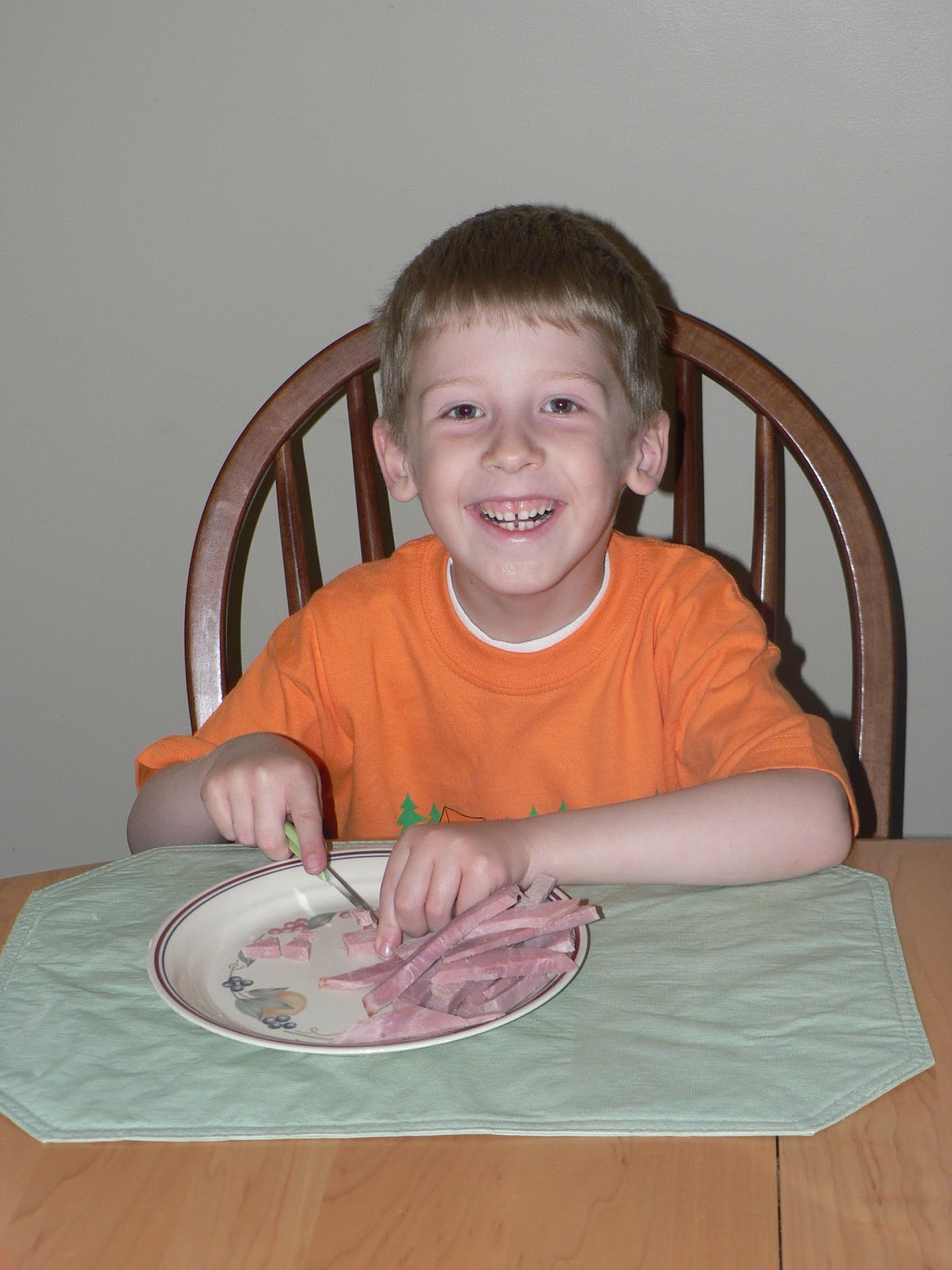
I allow the older ones to use paring knives but a simple table knife or plastic knife is sufficient for most foods.  I often cut them into slices and then they cut them into bite size pieces.  So when you have some left over ham...either make pizza :-) or have them cut it for you to put in the freezer for another day.  Other food items easy to cut: cantaloupe, watermelon, peppers, cucumber, bananas, bananas, cooked chicken, cheese, peaches, pears, green beans, potatoes, etc.  Really, anything with the exception of raw meat.  :-)  Celery is a challenge due to it's "stringy-ness" but older children can usually handle it.

Salads (fruit or vegetable) are also a great thing for children to be preparing.  Tearing the lettuce into small pieces is an awesome fine motor skill.  And I find that if they make the salad themselves, they are more likely to eat it.  Vary it...let them add mandarin orange and almonds, use a variety of lettuce/spinach, apples and sugared pecans (for older children and with supervision, let them make the pecans), variety of veggies, etc. 
I find that I very seldom take pictures of my kids in the kitchen because I'm usually doing something too...and by the time I remembered this time...she was almost done!  But see the salad?  She made that. Wow!  Talk about "sticking it out" until the task was done!  Yeah!

Muffins---they can pretty much do the whole thing...using paper liners adds additional fine motor and math components as mentioned in a past blog. 

Cookies---Again, pretty much on their own.  You just can't expect perfect shaped cookies...unless you have a son like mine (who's older then preschool age) who does better then I do.  :-) 
Actually, those scoops, make it easier for the children to make more uniform cookies.  This small one is easily used by my preschoolers.  I find that the next size up that I use for muffins is a little more difficult to squeeze so I fall back on the measuring cups when we are filling the muffin liners.
Cookies/cupcakes...let them decorate!

PB sandwiches are great for fine motor and coordination.  Other sandwiches also are kid friendly to make. 

Have leftover boiled potatoes?  Let them slice them for fried potatoes.

Making bread?  Let them mix and knead.

Making meatloaf?  Place the crackers into a freezer gallon bag and let them use a small roller, a child's hammer, or even their hands to crush them up.

Purchase a new pair of children's scissors and designate them as kitchen scissors.  Use where appropiate.

Break spaghetti sticks in half prior to cooking...they find this fun.  And it's less messy to eat!

Your child can always do something to help in the kitchen.  I understand there are time where "it just needs to be done" or we are just having a grumpy day and it's better we do it ourselves (yes, speaking from experience) but when you can, include them!  It really helps with attitude also.  No offense to my mother...I love and respect her (and I understand because I'm a lot like her), but we didn't spend much time in the kitchen with her growing up and when we were out on our own...hmmm, "I don't know how to cook."  Well, that was really just an attitude issue.  I believe anyone can cook if they put their mind to it and can read a recipe.  :-)  But including them now makes for children with a good attitude toward the kitchen...male and female alike!  Please let your sons in the kitchen!!!  I'm one that has benefited from having a husband who is very capable in the kitchen!  It's not just the woman's job anymore.  :-)

Also, remember to include your children in shopping trips, when possible.  You can teach about food groups, healthier choices, staying in a budget and wealth of literacy and math concepts.

You may wish to consider including them in finding new recipes...or choosing the menu.  I know some families where the children have a day where they make a meal for the family (it can be a very simple meal of crackers, cheese, cold meat, popcorn, apple slices...but it's still a meal and THEY did it!)  Encourage them to look through cookbooks and when they find a picture that looks yummy...go through the steps with them.
1)  Let's read the recipe.
2)  What ingredients do we need?  Do we have it all here or do we need to put it on the shopping list?
3) Prepare it, including your child
4) Eat and review.  Whatever their opinion is...expand on that.  So if they say, "good"...or if they say "ew!" say, "Tell me about that."
5) Consider making a child's recipe book.  Let them recall how they made the meal.  Help them write the name of the recipe at the top of the paper and draw a picture about it.  Then have them dictate the steps to make the meal.  Write it down exactly how they said it.  It'll be a keepsake for the future, that's for sure.  You may wish to attach an index card with the actual recipe to the page as well, that way if they go through "their" cookbook to find a meal...then you have the actual recipe to go by.

Kitchen Chores
Involve your children in the daily upkeep of the house. You'll be glad you did.  At first it will seem like more work for you...but it'll get better.  I promise!  In the kitchen they can
*  Clean up after they have prepared a food.
* HAND wash a few of the dishes.  This is a great sensory activity also.  
*  Wipe the table/counters/chairs.
* Sweep
*  If you use a sanitizer, allow the children to use that spray bottle.  We use Melaleuca products. Melaleuca is a company that strives to provide "safe for the family and environment" cleaning products as well as much more!  Our kids have really been involved in cleaning all through the home now that I don't have to worry about chemicals as much.  :-)
* Fill and empty the dishwasher.
* Straighten the cans in the pantry or the spices in the cupboard.
* Set and clear the table.

A side note: If you do not do family-style serving...consider it.  It takes a bit but they do become more capable with practice.   On top of the fine motor benefits, they learn about portion control, manners and patience!  Also, be sure to include a table knife with your preschool aged children and let them use it to cut their meat, veggies or use it to coordinate with their fork/spoon instead of using their fingers.  :-)

Hope your week goes smoothly!