Thursday, March 17, 2011

GREEN!

Happy St. Patrick's Day!  :-)  As a rule we don't "do" holidays in our program.  But without going into too much change of routine we did have a green day today.  Didn't really need to dress in green as most of us had some sort of green on us before the morning was done.  :-P

This activity was the main culprit for getting us stained.  :-)  But it's well worth the mess.  It's one of those activities the kids love to do over and over.  The children cut out a large shamrock and we made green bubble prints on the shape.  What child does not like to blow bubbles? 
It's wise to practice blowing through a straw.  Yes, there was a couple that got a green tongue and tasted a wee bit of soap...but really, they only do it once.  It's relatively harmless.  Just water, food coloring and soap.  Be sure to use a tray/pan underneath your bowl, as you can see the bubbles do tend to erupt over top so you don't want to have to worry about it.  Since it has a soap inside, the food coloring washes off the tray very easily.  Use LOTS of food coloring for a bolder color.


Another favorite and if you can believe it, we didn't do it all winter!  My eyedroppers seem to have found a new home somewhere other than where they should be.  Not surprising if you have ever seen my computer/work/storage room!  So looking for something else I stumbled across some more.  :-)  That's a nice thing about a large set.  Mine are plastic and are the "old version" with the black stoppers.  You can still get them at www.discountschoolsupply.com in a set of 12.  I prefer them over some of the newer "one piece" droppers.
I love to hear their excitement when they have made a new color.  Of course, they all tried to make green first because that is what we were focusing on.  Most made "snow cones".  Eyedroppers are great for fine motor!  

I really wanted to offer Incredible Foam this morning (it was green :-P) but unfortunately I could not find it...though I did find the eyedroppers!  I'm sure it'll show here soon now that I'm wondering where it's at.  So we did playdough again, child choice.  :-)  Chose a tool we don't often use and added a ruler to encourage measurement.  The younger ones don't usually use it unless it's suggested.  However, my oldest student is beginning to show more self-direction (which is something I look for in my preschoolers...and usually see at then end of 4 years beginning of 5 years) and he was quick to use that ruler without me saying a word as well as using the sticks for nonstandard measurement. 
Tip:  Provide them with two colors of playdough because often they can't refrain from mixing them together and that really gets them using the muscles in their hands!

A switch from the easel today.  Definitely was messier than an easel but that allowed for them to take responsibility for their own mess!  ;-)  I thank Melaleuca for providing family safe cleaners that actually do an excellent job!  The children learn life-long practical skills. 
"Hey, your tongue still green?" 
They did enjoy the switch to sitting and painting at the door.  (Excuse the mess outside, our lovely "puppy" has made a disaster of our yard.)  I do want to remind you all though that standing at a wall or easel is excellent for writing as well as for art work.  It strengthens the shoulder muscles which in turn promotes stability and wrist position.  This supports a proper/mature writing grasp.

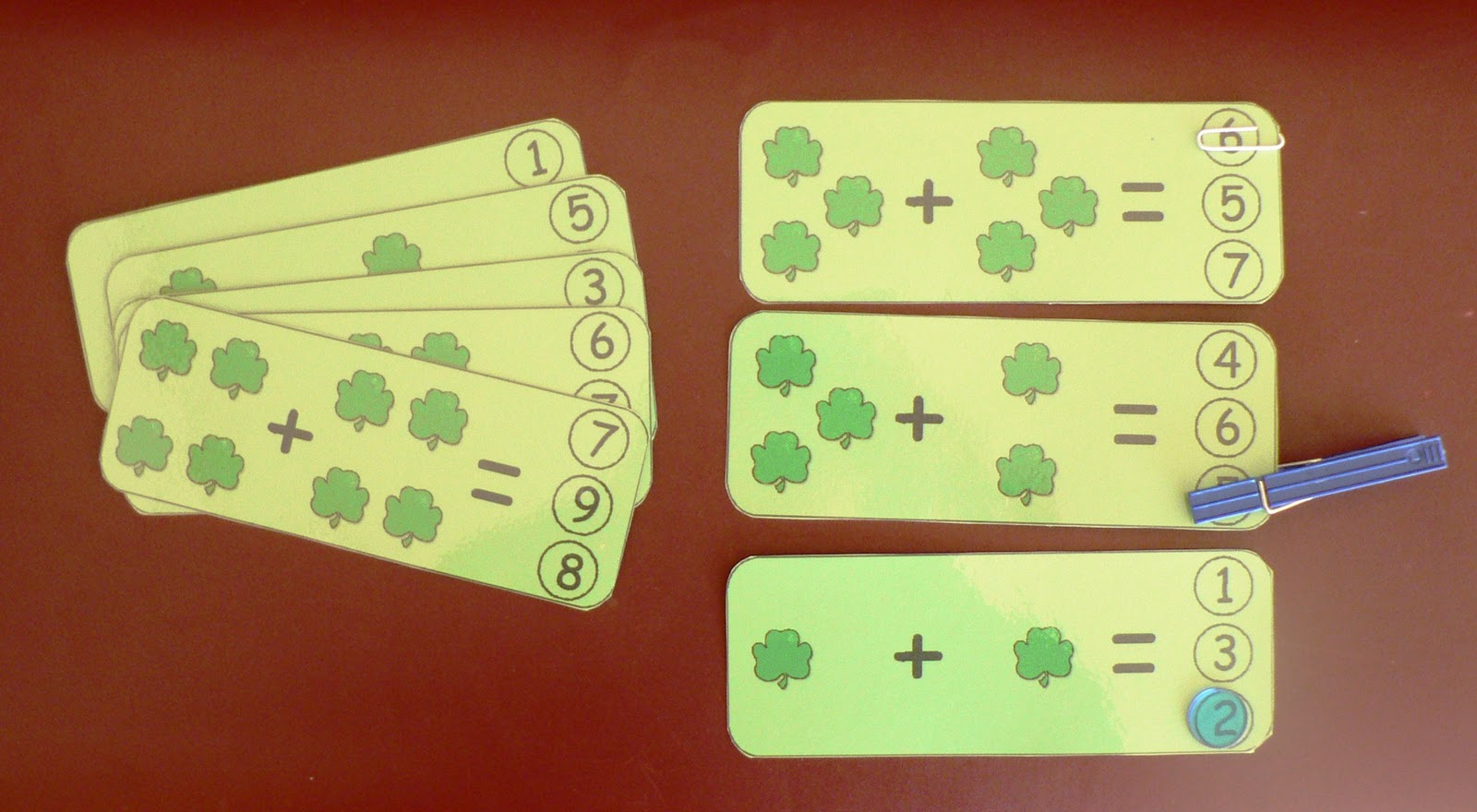
For math, we did the shamrock addition that was mentioned in a recent blog.
I provided a small amount of dried beans in a bowl, to be used as manipulatives, and clipped eight clothespins around the edge. 

Enjoy the beautiful weather!  We plan on heading back out after a brief rest time today.  Older kids are home from school, half day.  Parent-teacher conferences.  And we have the sand box cover off for the first time all winter!  YIPPEE!

Wednesday, March 16, 2011

Mathematics and Preschoolers IV

Concept of Zero
I actually teach the concept of zero at the beginning of the school year.  With just a few mini lessons they begin to understand that "nothing" or "all gone" is represented with the number zero.  This concept needs to be understood so that when working with sets, addition and subtraction, they understand that 'none' is actually zero.


Humor and preschoolers go a long way!  Here is one little activity that doesn't take much time.  We usually do this as a group because laughter is contagious and the more we laugh the easier it is to learn (my opinion :-P).  I have my flash cards handy with a numbers less than 5.  I don't want large numbers here and you'll understand in a moment, it would be time consuming!  So a child chooses a card (I usually make a big deal about them "not peaking", gets us started on the right foot with laughter) tells the rest of us what number it is.  I often encourage them to trace it.  As a group we clap, stomp, jump it out.  Usually whatever action the child wants to do.  Then that child goes to the toy shelf and "makes a set" for that number.  He brings it back and we count it out.  After each child has done that I start asking, without cards, "how many" questions.  How many chairs in Ms. Amber's living room?  How many pianos?  How many windows?  How many doors?  Then I slip in a funny one.  How many elephants?  "What?!  There are NO elephants?  I was sure that was an elephant in my bed this morning.  (They all jump up to look.).  All dissappointed I say..."Oh, okay, you're right.  No elephants.  What number is that?"  Typically with little ones you have to tell them.  Show them the flashcard that has the number zero on it.  Then we keep going.  How many phones?  How many giraffes?, etc.


After this intro activity you can easily slip "zero" into many counting sets activities.  Use muffin tins with liners, write a number on the inside, include zero.  Give them a supply of manipulatives and have them put a corresponding number of manipulatives into each muffin liner.  Reinforce that 0 is none.


At the end of snack time, ask...how many crackers do you have now?  "None...I ate them all!"  Yes!  You are right.  What is that number?  "0".  You bet!


When you have a number/set display on the wall, be sure to include zero.  If you are creating number collages, put a 0 in there and encourage them to tell you that we won't be gluing anything on it because zero is "a big nothing" (That's from Leap Frog's, Math Circus DVD.)
----------------------------------------------------------------------------------------------
Sorting , Compare, and Classify
Prior and along with learning how to pattern, it's important that children work with sorting, comparing and classifying.  It helps them begin to notice characteristics which will then lead to the ability of beginning to understand relationships between objects which will lead to patterning.

I find it important to be sure to use the terms sort and categorize.  I knew many children who could sort a set of objects once I began to show them what I meant but they didn't understand what the term 'sort' means.  And that is one term that will benefit them in knowing. Then we begin with sorting objects by one characteristic. Family chore:  have the children sort/fold towels or sort and match socks or sort clothes according to sibling.  Starting out, give the child a set with very obvious differences.  So perhaps you want to start with a basket full of buttons, keys, and toy cars.  This is a very easy set to sort by one characteristic and very young preschoolers can even succeed.  And that is what we want.  Help them succeed then give them a challenge once they truly understand what the task is.  When the child can easily sort a set of objects by one characteristic (size, color, shape, etc) then give them back the set and ask them to sort "a different way".  With all sorting activities, encourage them to tell you how they sorted it.  This verbal description can be difficult for preschoolers but with repetition of the question and helping them with the answer, they soon begin to understand what you mean and that brings them to a new level of thinking.  I also find that categorizing activities are a great way to teach math vocabulary.  You can talk about size (big/small), quantity (more/less), various characteristics, weight (heavier/lighter) and so on.  Provide many oportunities for them to work with sets of various objects.

I love our chip and dip trays for sorting.  Clearanced at holiday or end of season times, you can usually get them for close to a $1.00.  At the dollar store you can find all sorts of baskets and pans that work great for preschool 'work'.  I like to keep a supply of their metal cookie sheets and muffin tins for sorting, magnet activities and even use them for painting.  Also, to give a child a visual you can simply provide them with strips of yarn and let them make a circle around each of their sets. 

Items to sort:
*  Craft foam shapes:  sort by size, shape, and/or color
*  vehicles: type of vechicle, color, size
*  blocks: color, shape, size
*  buttons: colors, shape, size, hole/no holes, shiny/dull
*  old keys (start collecting, you can use keys for many projects/activities)
*  coins
*  stamps
*  rocks/shells
*  letter/number manipulatives
* crayons
*  snacks- give them a "trail mix" and then have them sort their mix before eating it.
*  putting away silverware from the dishwasher
* pom poms
* items of nature (acorns, pine cones, leaves, etc)
* rubber insects from the dollar store
* craft sticks
* stickers
* clothespins
* wood shapes and other craft supplies

---------------------------------------------------------------------------------------------------
 Patterning:
I was planning on slipping in some pattern activities but I want to see if I have some pictures available for some of the patterning activities we've done in the past and time doesn't allow for that today.  I'll start with patterning with the next "mathematics and preschoolers" post.  :-)  Have a lovely day! 

Tuesday, March 15, 2011

Weather

Taking a break from "mathematics and preschoolers" as not much time this afternoon.  So will share a few pics from this morning instead.  We started our weather theme.  We did a very simple introduction to the water cycle this morning.  Used a variation of a lesson plan http://www.mo.nrcs.usda.gov/out/Lesson%20Plans/WaterCycle.pdf.  I had already planned the cotton ball absorption exploration.  We did talk about what we knew about rain and clouds.  I had a big gray cloud on the wall and we wrote what we knew on individual raindrops.  I did like the poster provided at the end of the lesson plan, kid friendly.  We used it today while introducing a new song.

If anyone knows the author to this song, please comment.  I was thinking it might be a Dr. Jean song.
Tune:  Oh, My Darling Clementine
Evaporation, condensation, precipitation on my mind.
These are parts of the water cycle and they happen all the time.

Children raised and wiggled their fingers on evaporation.  They clapped at condensation "up in the sky", and then lowered and wiggled their fingers like rain falling for precipitation.  We did talk briefly about percolation since it was brought up in their conversation and they love big words.  :-P

Math Activity
Children chose whether they wanted rain or snow coming from their clouds (blue/white playdough).  Then they chose two sets of two clouds and created their precipitation.  So she had seven raindrops under the seven cloud and was in the process of creating ten raindrops under the ten cloud.  Then they were able to explore with printing on another tray with different playdough.  We had potato mashers, forks, and etc

Scissors Activity
This was a very simple activity with minimal materials.  They cut out their cloud shape from gray paper.  Then they drew with crayons things that the rain help.  Grass and flowers were what I got the most.  Then they cut strips of blue foam into "raindrops" and glued them onto their paper like rain.  I also wrote down their dictation sentenced.  This one said, "Rain falls down to the ground and helps the flowers grow."  Dictation is something that comes with time.  Young preschoolers or those who haven't done much of this type of activity will often say something seemingly unrelated to their work.  That's fine.  Write it down.  That's what they wanted you to write.  :-)  Sentences that seem meaningful to us adults will come with time and experience.

Fine Motor Activity
With doing the cotton ball absorption experiment, I knew that it would be good for me to get the sponges out again.  They love this type of thing and so do I because it's working those muscles in their hands.  So this time we had a "pond of ducks" with no water in their pond.  They gave them water by squeezing "rain" on them.  Each child did this activity at least 3 times (we dump the water back in the bowl).

Today was full of "goodies" but nothing extremely "new".  Remember that repetition is important with our students.  That is why many center-based programs leave their activities out at their interest centers for multiple days.  Unfortunately, that isn't a possibility for me as a home-based teacher so I just make sure I repeat activities/skills, might vary it a bit but still the focus of the activity is the same.

Have a great day!

Monday, March 14, 2011

Mathematics and Preschoolers III

Adding and Subtracting Sets


When working with preschoolers, our addition and subtraction activities are going to look different than what a 1st grader does.  It looks similar to what Kindergarten students do, except we do a lot more with manipulatives where most of Aaron and Caleb's work was/is out of a workbook and using pictures.  Very seldom do they pull out the manipulatives unless a child is having difficulty with the concept...so it's important that those of us that have children going to public school...let's get them well-versed in manipulating sets before Kindergarten!


The easiest way to introduce adding and subtracting is through fingerplays/songs.  Here are some examples.


Addition
The Bee Hive
Here is a bee hive.  Where are the bees?
Hidden away, so nobody sees.
Here they come buzzing, out of the hive!
1-2-3-4-5.


5 Tall Giraffes
Lyrics by Colleen and Uncle Squaty Songcard-A-Props @2008
(Tune: Oh, My Darling Clementine)
1 giraffe, with his long neck, stretched to touch the sky so blue.
Call another giraffe to join him, all together there were 2.
2 giraffes with their long tongues, plucked the leaves from the thorny tree.
Called another giraffe to join them, all together there were 3.
3 giraffes spread their long legs, to drink the water along the shore.
Called another giraffe to join them, all together there were 4.
4 giraffes, long eyelashes, to keep the sand out of their eyes.
Called another giraffe to join them, all together there were 5.
All giraffes have long eyelashes, Long legs and necks and tongues.
So we’ve learned through the song we’re singing, many parts on giraffes are long!


One Elephant Went Out One Day
One elephant went out one day,
Upon a spider's web one day.

He had such enormous fun.
He called for another elephant to come.

Subtraction

These are familiar songs that my students love to dramatize!  I won't add the lyrics, I'm sure you know them!
*  5 Little Monkeys Jumping on the Bed
*  5 Green and Speckled Frogs
*  5 Little Ducks When Out to Play


Hands-on is the way to go with addition and subtraction.  Young students need to be able to touch and move the manipulatives around so they can understand exactly what it happening.  It helps it be a bit more meaningful vs. abstract.


A favorite with my kiddos was our Addition Mat.  I found something similar in one of the many catalogs that comes through our house and thought…”I can do that.”  So I went searching for it so I could take a picture for you all, and do you think I can find it?  Nope.  Hmmm.  Will have to be on the look out for it.  I went looking for the site that had the addition mat for purchase and lo and behold I found someone who has a free printable called "Add It!" that was very similar to ours.  http://confessionsofahomeschooler.blogspot.com/2009/11/my-printables.html.  It's a ways down the page under "Math Skills".  She also has a "Subtract It!" printable.  With hers, she has flashcards you can print off and laminate.  I made mine so I could use the flashcards  I already had.  When I find it I'll be sure to put a picture out here for you.
Photo is from http://theadventuresofbear.blogspot.com/2010/10/math-monday-addition.html.

Here is a picture of one I made years ago.  Again, laminating it makes it more durable and allows you to use dry erase markers if you wish.  I like the newer "add it" mat better.  :-)
You can easily make addition activities theme related.  Here is a picture from Dr. Jean’s site.  http://www.drjean.org/html/monthly_act/act_2007/10_Oct/pg05.html
You could do as she has shown with the addition. However, one activity I like to do is let them explore with sets.  The way I’ve done this type of activity is to put the number on the stem (if you laminate them you can use dry erase marker and reuse over and over) and give them a set of pumpkin seeds to correspond with that number.  1 set per pumpkin.  Then they create their own addition problems.  For younger students I’ve created squares for them to give them a visual of where their 2 sets are needing to go.  Then we use dry erase markers to write the numbers under each set.  So for the number Dr. Jean used, 7, we’d have 0+7, 1+6, 2+5, 3+4 (and with older students you may wish to go back with the reverse of these facts, 4+3, 5+2 and etc).  Themes:  you could do bears with bow ties and the number in the bow tie.  Or snowmen with hats with the number in the hats.  Use your imagination.
Dominoes are always fun for kids.  They love to build walls with them.  So often I’ll have a little task for them to do before they start playing with the dominoes.  They choose five dominoes and create addition problems with them.  Tactile numbers or other manipulatives work well here.  They count the dots on one side of a domino and find the number, then we add a plus sign, then they count the dots on the other side of the domino and they find the number.  We add the equal sign and they count them all together.

Index cards come in handy for addition facts.  Here is an activity we did with links.  For my preschoolers I like to color code.  It adds a bit of color reinforcement and also gives them a visual for a set. 

Don’t forget your toys!  We have a set of Counting Cookies, a product made by Learning Resources.  You can find them on Amazon.com, at Target, Wal-Mart and so on.  You can do simple addition right in the middle of their play.  Unifix or linking cubes work very nicely for showing children that addition is putting two sets together.
www.childcareland.com also has free addition strips that you can print.  Here are a set that goes along with St. Patrick's Day.  Add a little fine motor and use clothespins to mark the answer.  These are a nice transition into using pictures for adding.  The pictures are still large enough that they can place a bean or chip on them if the child still needs that hands-on component.  Also, I like that they are individual strips. Keeps the children from getting distracted by the busyness of a typical workbook page.


Subtraction
Young children need to physically take an object away to begin to understand what subtraction is about.  As with addition, though we focus on  “manipulating manipulatives” :-) you do want to make times that you are showing them the subtraction problem.  So put the tactile numbers or number stamps to use or let them practice their numeral formation. 
Craft Sticks:  Here is something we almost all have in our cupboards if we have kids.  Like with addition activities, index cards can be your friend, or you can use flashcards.  
Wooden beads on a dowel or lace or abacus.


Dominoes work well also, except make sure you choose ones that have a large and small number and be sure to have them start with the large number (more/less).  Add interest by putting them in an adult sock.  They love the “mystery” of it.
Use your flashcards but remember to add some manipulatives.  Mini erasers work nicely!  I purchased a 500 Mini Eraser Assortment for $9.99 through Oriental Trading. 
Snack time is a perfect time to experience simple subtraction.  Start with 10 crackers, eat 2.  How many are left now?  Let them decide how many they are going to eat next.  Yum!
Number line…you can show subtraction and addition very well on a number line.  During February, blog titled Calendar, we had a valentine monkey jumping from number to number.  So the flash card said 3+4.  Children moved the monkey to the number 3 and jumped him 4 more times and then told me the number it landed on was 7.  For subtraction, you can use the flashcards also.  Start the object on the highest number and jump backwards.  You can create a large “number line” on the floor with number mats or outside with sidewalk chalk.  Children start at a number and jump forward (adding) or backwards (subtracting).  It’s all about exploring!


Friday, March 11, 2011

Mathematics and Preschoolers II

Tactile Numbers
Our set allows us to work from 1-30.


Number Recognition and Numerical Order go hand in hand, in my opinion.  Number recognition comes with working with the numbers.  Handling them (tactile numbers), talking about them, looking at them, singing about them and doing hands-on activities that deal with numerical order.  So, we'll start there.
*  Number Lines:  A number line is a great way to give children a visual regarding how numbers work.  And, it'll come in handy when working with skip counting and adding/subtracting.  You can just simply sticky tack up number flashcards in a line to make a very simple line.  Or you can create an actual "number line" like we did for the month of February.  You can see a picture of that in the Calendar blog.  That one was foam craft hearts with the numerals written on and a piece of yarn stringing them together.
* Make it theme related.  One year we were working with the theme regarding bears.  On the wall I put up a cutout of a bear and the children had "paws" with numerals written on them and they put them in order going away from the bear.  
*  Use sidewalk chalk outside and create a "train track" and put numbers in each section.  Then pretend to be a train, choo-chooing along, stating the numbers as you pass them.
*  Slip in Dot to Dot activities here.  I suggest having a number line available for them to refer to when they need help knowing what number comes next.  A simple way of doing this is to write them on a piece of adding machine paper, then you can roll it up and rubber band it to keep it in good shape until next time.
*  If you have a children's xylophone, put a circle sticker on each one with a number inside.  They can count as they bang on the xylophone. 
*  Shelley Lovette posted a free printable yesterday on her site called Rainbow Learning Links Number Sequence. http://www.childcareland.com/free.html This address is to her Free Printables page and this particular printable's link is at the bottom.
*  For some reason, young children like paper chains.  :-)  So might as well incorporate some learning there.  If you provide a piece of construction paper with the lines drawn on them, and in each rectangle have a number, your child can get their scissor practice in by cutting out the strips and then gluing/taping them together and creating a number chain.
*  Place your number manipulatives into a sensory tub.  Encourage your child to find them and put them in numerical order before playing with the sensory.  My kiddos enjoyed me putting our magnetic numbers inside of a tub of water and letting them "go fishing".  Then they put them up on the magnetic dry erase board.  (We also did an alphabet/number sort the same way.)
*  I use our linking cubes to encourage numerical order.  They put them in staircase order and then add a number manipulative or sticker.  This shows 1-5 but you child can go higher with the same concept.  My new learners that can't put them in staircase order are given the pattern to help them the first few times.


-----------------------------------------------------------------------------------------------------
Numeral Formation/Writing
Similar to the alphabet, you want the children to really recognize the shapes and lines that make up a number.  Here are some ideas that you can incorporate when you wish to practice number formation.
*  Playdough numbers, just like playdough letters.  Provide them cards with the number written on them, and encourage your child to create playdough worms to form the number.  Laminate your cards for extended use.  You can use laminated cards for number tracing with dry erase markers as well for other activities such as making yarn numbers.

It's been a few years since I printed these off and laminated them.  Glanced through the freebies section on the site.  I don't see these exact number posters but they have another set.

* Sensory Writing Trays:  a thin layer of salt, cornmeal, sand, shaving cream, fingerpaint, hair gel, and even yogurt or pudding.
*  Wikki Stix make for nice number formations and they can even make a set of "designs" for each number.  Wikki Stix make nice rubbings also and can be used as tactile numbers.
*  If you have a geoboard, children might enjoy creating numbers out of "geobands"/rubber bands.  You can make your own geoboard by using a square block of wood and hammering nails part of the way in evenly in rows.  I actually like the home-made ones better than the purchased ones because the tops of the nails keep the rubber bands on better.  :-)

*  My rubber dot and trace stamps make it nice to incorporate number formation for activities when the children really don't now how to write their numbers yet.  They can stamp the number and then trace it.  And most kids love stamps.
*  Stamps-that brings me to another activity we've done.  Block numbers and stamping inside the number, following the correct formation.  Our Stamper Assortment from http://www.orientaltrading.com/ have worked well for these types of activities.  And they've lasted a LONG time. 

*  Magnets.  I created my own theme related magnets by using those lovely die cuts you can buy at teacher's stores or through their catalogs. In this activity, I laminated the apples and added a strip of magnet to the back.  Then I wrote the numeral on the dry-erase board and the children added the magnets as they would write the number.

----------------------------------------------------------------------------------------------------------
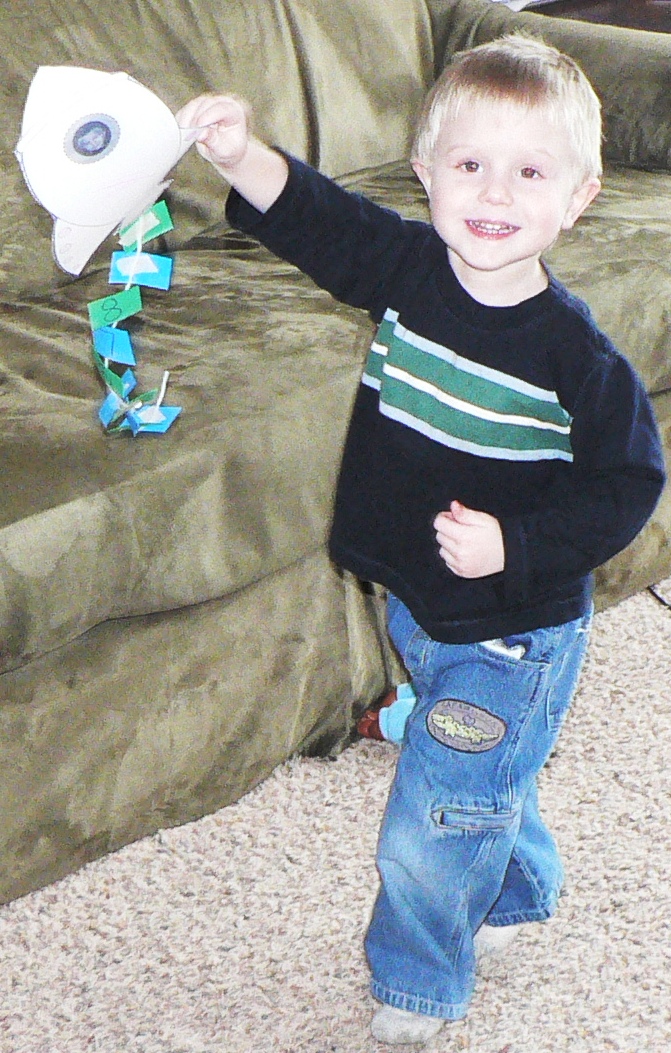
Oral Counting does have it's place.  Really, if you are doing a lot with counting objects and number recognition/numerical order...oral counting will just fall in line and the children will get it.  After all, it's memorization.  After children can count to ten with no difficulty and you are working on counting higher...then consider mixing it up a bit.  :-)  Teach the children to count backwards from 10-0.    The children enjoyed our Blast Off Rockets we made during our transportation theme.  They cut out the rocket (I had their picture on it like they were looking out the window) and we taped on yarn and number squares from 10-1 down the yarn. 
They also enjoy 10 in the Bed book and activities.  We made a "bed" by folding a piece of construction paper and then slipping in 10 craft sticks. 
When children can count to 20 and higher, consider teaching them to count by 10s and 5s.  Even though my students are unable to count to one hundred...it makes them so proud to count with me to 100, by 10s.  We use a song to help them remember.  Some fun ways to count:
*  Bounce or roll a ball back and forth with your child and count.
* Ten Little Indians song is a perfect piggyback song.  We've done "1 little 2 little 3 little birdies" for a bird theme as we added flannel or magnetic birds.  You can also do it backwards.  For added number recognition, put the numbers on your birds.
*  Children love flashlights.  An activity from Numbers for Little Learners, another Mailbox publication suggested that you have a set of number cards out of order, say the rhyme.  Then the child counts out loud as they shine the light on each number.  So as you can see, number recognition, numerical order and counting all go hand in hand.
   These numbers are mixed up!
   These numbers aren't right!
   Put them all in order.
   And then shine the light!
*  I have the "Get Up and Go" dice you can purchase from www.discountschoolsupply.com.
I have their cards that go with it, action and number/dots, because it's a set.  But the nice thing is you can put your own pictures in there also.  Easy clean so we can use them outside during nice weather.  Sometimes I just use the numbers but sometimes we use the action cards also.  So a child rolls the action dice and then the number dice and count out loud as they perform that action the corresponding number of times.
*  Here are some songs I've used in the past.  (Authors unknown, sorry I can't give credit to those that deserve it!)
   Hop, Hop, Hop
  Find a foot and hop, hop, hop!
  When we're tired we stop, stop, stop.
  Turn around and count to (ten),
  Find a foot and hop again.

  Finger Counting Song
  (tune: Bingo)
   I have five fingers on this hand and I can count them all.
   1-2-3-4-5, 1-2-3-4-5, 1-2-3-4-5.  Yes, I can count them all.
repeat with other hand, then...
   How many finger do I have when I count them all?
   1-2-3 and 4, 5-6-7-more,8-9-10 for sure. I counted 10 in all!

   Tiptoe, Reach, Wiggle
   Stand on your tiptoes
   Reach for the sky.
   Wiggle your nose
   and blink one eye.
   Snap your fingers.
   Okay, then...
   (count) with me from one to ten.
   1-2-3-4-5-6-7-8-9-10.
      (You may wish to substitute count with hop, clap, jump, etc)

Skip counting songs:  I vary seldom get past 10 in 2s because it seems "too much" for most of my kiddos but with practice they can do it.  Counting by 2s goes well with talking about the vocab "couple" and "pair".

2-4-6-8-10-12-14-16-18-20
Our legs, our arms, our hands, our feet
We count in pairs of two.
2-4-6-8-10-12-14-16-18-20
Our eyes, our ears, our socks, our shoes
We count on me and you.

The Skip Count Song
(Tune:  Skip to My Lou)
Skip count, skip count, count by 2's
We can count to 20.
   (then count, you can change to "count by 5s and so on.)

Happy counting!

Thursday, March 10, 2011

Mathematics and Preschoolers

I noticed that there are a lot of posts with regards to literacy and though I've touched on mathematics here and there I really haven't given many details.  An activity we did this week made me think about it a little more.


Okay, I see scissors- gray cloud.  I see literacy- upper and lowercase R rain drops.  What's the math?  We were reviewing 1:1 correspondence and counting to 10.  Preschoolers need quite a bit of experience with 1:1 using concrete objects and activities so that they can internalize 1:1 for counting with meaning.  Underneath the cloud were black line raindrops.  The children were given a bowl of raindrops.  Some had R, r on them and others did not.  They sorted the raindrops and glued (liquid glue bottles helps children strengthen their hand muscles and teaches them control!) a raindrop to each black line raindrop. That is a 1:1 correspondence activity.   When counting sets of objects, I encourage my students to "touch them".  You know a child has internalized 1:1 when they can put 1 finger on one object in a line and continue through the set with 1 finger on each object and counting one number higher and make it through the whole set.  Typically, I see very young preschoolers just run their finger over a line of objects as they count, sometimes randomly.  As they gain experience they make it to the 3rd or 4th object before their oral counting or their finger gets ahead of the game.  So it's important to do activities to help children internalize this 1:1 concept.  Here are some more hands-on approaches that you can incorporate in your activities.
   *  Icecube trays:  Use tweezers or small tongs and encourage them to put on pom pom (or other object) into each section.  You can also use muffin tins.  Here's an idea for Spring since we all are looking forward to it.  Back to Pre-K pages.  Check her website out if you haven't yet already!

   * Math Mats:  You can make these relatively easily on your own.  I do mine in Print Shop, if I have a specific theme in mind.  My most basic one is called "Cover-Up".  That way I can use it over and over and adjust the manipulatives according to the theme.  The children are given dice.  Use only one if they can only count successful to six.  Use two if they can count higher than six.  If they can't make it to 12 yet, that's fine.  The larger the number...the larger the grid needs to be.  You can help them along.  I like foam dice because 1) they are typically bigger so the dots are easier to count and 2) they are quieter!  Children roll their dice, count the numbers and place that many objects in each square.  They finish when the grid is filled.  I've used theme related stamps, stickers and erasers.  www.orientaltrading.com has many options for small erasers.  Ours never get used for "erasing".  All used for math manipulatives.

   *  What child doesn't like to play with water?  Those little rubber ducks you can get through Oriental Trading and other places can be used for 1:1 reinforcement.  Fill a shallow bowl with water-I like to use a blue tub to represent a "pond", have a good number of ducks handy. Have them roll the dice, count the number of dots and place that many ducks in the pond.  Continue as interest keeps.  You don't have rubber ducks?  Cut a few from yellow or white craft foam.  They float.  Add a spray or squirt bottle and see if they can make the ducks swim by squirting them with water.  And of course, you can also do a paper pond and paper ducks...but the water does add interest.
  *  You can create 1:1 activities using objects around the house like...putting 1 hat on each doll.  Or you can use pictures...have clipart of children in rain gear and encourage your child to give them each an umbrella (I've used craft foam and pipe cleaners for umbrellas.)
  * Also remember that setting a table incorporates quite a bit of 1:1.  Most preschoolers can have success at this family chore!


-------------------------------------------------------------------------------------------

Another math concept that I've touched on in the past is conservation of number.  Children tend to think that quantity is influenced by size.  That's because they depend quite a bit on visual cues.  This concept is really only internalized with experience so slip them in when you can.   No reason for frustration.  Children will eventually get it.  You just provide the experience. Here's a youtube video:  http://www.youtube.com/watch?v=jWQZR6uWxLM  
Ideas:
   *  When you have a set of objects that you are counting, one time squish them all together and count them.  Then spread them out into a longer line and ask how many there are now.  Most preschool children will begin to count again because they think there are more now.  Do it a couple of times to show that, really, it's the same number.  You can do this with two identical sets of objects...squish one set together but spread out the other and compare and then count together.
   *  With playdough, create two equal sized balls.  Talk about how they are the same size.  Then have your children make a snake and then you make yours into a snake, either larger or smaller.  Then talk about which one had more/less playdough.  The answer is, they were the same amounts of playdough.  Show them that by rolling the snakes back into their balls and comparing the sizes.
   *  If you are focusing on a specific number, then provide some material that the children can make various sets out of.  So maybe you are working on the number 9.  You have provided a bowl of elbow noodles.  (Hey, get that literacy component in there...nine noodles :-)).  Then have your child make nine sets of nine.  Encourage the children to glue them on together in a set, arranging them differently.  I have used a different colored marker and circled around each set when they were done so they didn't confuse one set from another.  Then of course, we reinforced counting to nine, how many times?  18-20.   :-P First when we were introducing the activity, then as we counted out nine sets of nine, then we counted each individual set as we glued it to the paper, then to "check our work" we counted the sets on our paper to make sure we had nine sets. 


--------------------------------------------------------------------------------------------------------

Our K standards state that a child should orally count to 10 before Kindergarten.  10?  I guess, if a child has minimal experience.  But most of my students can count between 20-30 before going to Kindergarten.  It's all about experience.  And once they learn the pattern of counting they are good to go.  Counting orally has it's place.  It's like singing the ABC's.  It's memorization and it's a good intro to numbers and numeral names.  Here is a skill that seems so simple to us.  I do not formally teach this skill.  It's another skill that comes in time with experience and when the teacher/parent is aware of it, then they are more apt to reinforce it whenever possible. To eventually be able to add and subtract, children must first recognize a number and be able to give a concrete example of the number. In preschool, we "count with meaning".  Counting with meaning is that of counting a concrete set of objects, using 1:1 correspondence and knowing that the last number you say is the total for that set.  So try it...does your children really know what the total of the set is?  With repeated experience I find that most 4 year olds will understand that the last number they counted was the total.  And when I ask..."how many was that?" they will give me that last number.  But children with minimal experience with counting concrete objects and very young preschoolers will give a random number when you ask "how many was that again?", will just count quickly from 1-10 (or whatever number they can already successfully count to), or will begin to use 1:1 and count the objects again.  So check it out!  Next time you count a set of objects with your child, ask "how many was that?"
   *  Count, count, count.  You can count informally all day long!  
       How many bowls on the table?
       How many spoons?
       How many cans of tomato soup are in the cupboard?
       How many envelopes did we get in the mail today?
       How many jumps do you think it's going to take us to get to the door?
       How many wheels are in our garage today?
       How many long is your train?  Count the cars.
       How many crayons do we have to write with today?
       How many green beans did I put on your plate?  
  *  This is the category that I often put matching number to set activities.  You can find many of these type of activities on the Internet to print off.  The easiest one to do which requires minimal preparation is to use your number flashcards...the ones with sets of objects on one side and the number on the other.  Most people have flashcards available.  You can find them at almost any store, including dollar stores.  Have them place their number manipulative on the corresponding card.  With this type of activity they are counting again and again.  :-)  To add interest you can do like we did awhile ago and place the number manipulatives inside of a tub of sensory material.  Let's see, that was the blog titled Five Senses.  There is a picture there to give you an idea of how we did it.
-------------------------------------------------------------------------------------------------------------
Some of the math skills that we'll touch on are
*  numeral formation/writing
*  nonstandard measurement
*  patterning
*  sorting/classifying
*  numerical order
*  more/less/equal
*  beginning geometry/shapes
*  oral counting, including skip counting
*  adding and subtracting sets